3 min read Last Updated : Nov 17 2025 | 9:13 AM IST
After days of ‘severe’ air quality, Delhi saw a slight improvement on Monday, although pollution levels remained firmly in the ‘very poor’ category. Residents woke up to a thick layer of smog, with the Air Quality Index (AQI) crossing 350 at most monitoring stations. However, some locations still reported ‘severe’ air quality.
At 8 am, Ashok Vihar recorded an AQI of 382, placing it in the ‘very poor’ category, according to Central Pollution Control Board (CPCB) data. Other stations logged similar readings: ITO at 392, Rohini at 404, and Punjabi Bagh at 383.
By 4 pm on Sunday, Delhi’s 24-hour average AQI stood at 377, also in the ‘very poor’ category. CPCB data showed that 18 monitoring stations recorded air quality in the ‘severe’ category, while 20 showed ‘very poor’ air with readings above 300.
As per CPCB classification, AQI levels are categorised as: 0–50 ‘good’, 51–100 ‘satisfactory’, 101–200 ‘moderate’, 201–300 ‘poor’, 301–400 ‘very poor’, and 401–500 ‘severe’.
Delhi Environment Minister Manjinder Singh Sirsa said that pollution in the capital is currently driven mainly by PM10 emissions from construction activity, dusty roads, and traffic congestion. He added that the government is intensifying efforts to identify pollution hotspots, reported PTI.
With winter setting in, accumulated dust is turning into smog, further reducing air quality. Sirsa also said emissions from industrial units relocated to neighbouring regions continue to affect Delhi’s air.
According to the Decision Support System (DSS) of the Indian Institute of Tropical Meteorology (IITM), Pune, stubble burning accounted for 16.3 per cent of Delhi’s pollutants on Saturday. Vehicular emissions contributed 18.3 per cent, the highest among all sources.
The Supreme Court is scheduled to hear on Monday a plea related to stubble burning, which has further worsened air quality in Delhi-NCR. The court had earlier asked the Punjab and Haryana governments to update it on action taken to control the situation.
A bench of Chief Justice BR Gavai and justices K Vinod Chandran and N V Anjaria had agreed to hear the plea on 17 November. On 3 November, the court directed the Commission for Air Quality Management (CAQM) to file an affidavit detailing steps taken to prevent further deterioration in Delhi-NCR’s air quality.
The India Meteorological Department (IMD) has forecast a mainly clear sky, with shallow fog at most places and moderate fog in isolated areas during morning hours. The maximum temperature is expected to range from 24 degrees Celsius to 26 degrees Celsius, while the minimum is likely to hover between 8 degrees Celsius and 10 degrees Celsius.
The IMD has also issued severe cold-wave alerts for much of central India. While the north, west and central regions brace for fog and cold-wave conditions, the southeast is expected to receive rain and thunderstorms.

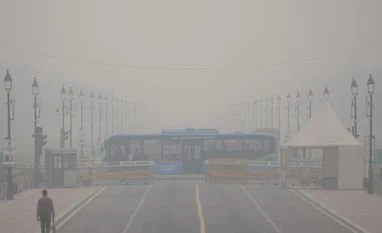 "Delhi sees small AQI improvement but pollution stays in 'very poor' band")

