Prime Minister Narendra Modi, in his address on the 79th Independence Day, underscored the need for India to be self-reliant and innovative in its use of technology. He emphasised that building digital sovereignty is essential to reduce dependence on foreign companies for tech services.
“Every nation, which mastered technology, scaled the heights of development, reached the pinnacle, and attained new dimensions of economic power,” he said, urging the country to master critical technologies.
PM Modi highlighted India’s progress in the semiconductor space. The first Made in India chip “manufactured in Bharat by the people of Bharat, will be available in the market” by the end of this year, he said.
“Today, we have freed ourselves from that burden and advanced the work on semiconductors in mission mode. Six different semiconductor units are taking shape on the ground, and we have already given the green signal to four new units,” Modi said during his 103-minute speech, the longest in his ongoing tenure as the Prime Minister of the country.
Under the first phase of the India Semiconductor Mission with an outlay of ~76,000, the government has so far approved 10 semiconductor chip fabrication and packaging units. In June 2023, the government approved a $2.75-billion project proposal by Micron to establish a semiconductor chip Assembly, Testing, Marking, and Packaging (ATMP) unit in Sanand, Gujarat.
A few months later, the government approved India’s first chip fabrication project proposal, a joint venture between India’s Tata Group and Taiwan’s Powerchip Semiconductor Manufacturing Corporation (PSMC), with an investment of $11 billion (approximately ~91,000 crore).
Since then, ISM, the nodal agency under the Ministry of Electronics and Information Technology, has approved eight more ATMP, Outsourced Assembly and Testing (OSAT) and compound semiconductor fabrication units.
Earlier this week, the Union Cabinet approved four additional compound semiconductor fabrication and ATMP units, of which two will be set up in Bhubaneswar, Odisha, while one each will be set up in Mohali, Punjab, and Andhra Pradesh.
During his speech on Friday, Modi also exhorted the nation’s youth to build indigenous platforms so that India’s wealth did not “go out” of the country. Citing the example of the Unified Payments Interface (UPI) platform, which is handling 50% of the real-time transactions happening in India today, the Prime Minister said that the ability to create something like UPI meant that the youth had power.
“Be it the creative world, social media or any of these platforms, I challenge the youth of my country… why don’t we have our own platforms, why should we depend on others, why should India’s wealth go out and I have faith in your capability,” Modi said.
The Prime Minister’s call for tech self-reliance comes as nations worldwide ramp up investments in artificial intelligence (AI) and cybersecurity amid geopolitical and economic uncertainty.
Jaspreet Bindra, co-founder of AI&Beyond, in today’s rapidly shifting geopolitical landscape, relying solely on foreign platforms means outsourcing capability, sovereignty and control.
“Building sovereign AI and homegrown digital infrastructure will ensure India retains its economic value, safeguards its data and jobs, and shapes technologies to serve its own strategic and business interests. We would not like to end up in a scenario where our digital services like DPI, DPG and AI platforms are at the whims and fancies of another nation,” he added.
The PM also called out on the youth of the country to build and create Made-in-India social media platforms and other technology platforms, but historically India has not been able to make a global mark.
One of the reasons is also as digital businesses have a tendency to favour the first movers in the space. India did try to create its own micro-blogging platform Koo, similar to X (earlier known as Twitter). Despite bringing local language support and several celebrities joining the platform it could not sustain.
Mayank Bidawatka, co-founder of Koo, told Business Standard that when it comes to technology we need to be patient with adoption and invest heavily in things that are important. “It could be research in medical breakthroughs, automation (robotics, AI, mfg), defence... so many areas. You just have to rethink what the future will be like and where countries and companies will get a competitive edge by owning the resource or the final product and start placing bets early,” he added.
Bidawatka urged that things of strategic and national importance need to be focused on and protected. “Create home grown companies or ask home grown companies to create solutions with tax breaks/incentives and protect these from outside competition for a few years,” he said.
Pankit Desai, co-founder and CEO of Sequretek, a cybersecurity firm, shared that the PM’s call to the youth to innovate in AI and cybersecurity is both timely and essential. “As cyber threats evolve at unprecedented speed, India’s ability to secure its digital future will hinge on indigenous innovation that blends advanced AI with strong security frameworks. At Sequretek, we believe this is an opportunity to not just consume technology, but to create globally competitive solutions from India.”

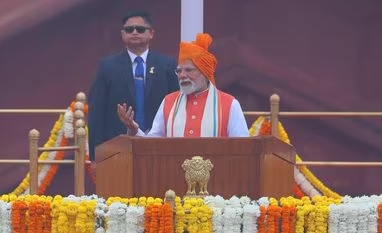 "First made-in-India chips to hit market by end of year, says PM Modi")


 Connect with us on WhatsApp