Diversifying global leadership: India's opportunity in a US+1 strategy

As the world diversifies its geo-economic reliance on one country, we should also diversify our geopolitical reliance on a single nation
US
ILLUSTRATION: AJAYA MOHANTY
Naushad Forbes
7 min read Last Updated : Nov 21 2024 | 1:21 AM IST
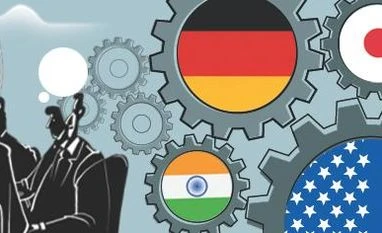
China dominates global manufacturing, currently accounting for 32 per cent of world output. The US, Japan, Germany, India, and South Korea follow at 16, 7, 5, 3 and 3 per cent, respectively. China is also the world’s largest trader (#1 in exports, #2 in imports) and by far the largest exporter of manufactured goods, from both Chinese and foreign companies. The world has sought to diversify from this overwhelming concentration in one country through China+1 geo-economics. While China remains a key manufacturing source, other countries, including India, seek to be that +1.  As the world diversifies its geo-economic reliance on one country, we should also diversify our geopolitical reliance on a single nation.
 
What constitutes world leadership? The US emerged from the Second World War with a dominant economy (accounting for 60 per cent of world manufacturing output) and by far the strongest military.  Several multinational institutions were constructed for the post-war period: The United Nations, the World Bank and International Monetary Fund, the World Health Organization, the World Trade Organization (that developed out of Gatt), the International Court of Justice, and so on.  These organisations have varied in effectiveness and credibility, but they gained their strength, particularly from the US’ support — and willingness to target any country with consequences if it didn’t follow the rules.
 
The US itself did not adhere completely to multilateral rules, but it did so enough to give them credibility. US leadership got other countries, starting with its allies, to follow these rules broadly too. And when a crisis hit, the US used its convening power to bring countries together — the G20 emerged from the financial crises of 1997 and 2009. The world needs to diversify from overwhelming reliance on US leadership. Our experience of President Donald Trump I should tell us what to expect from President Trump II: A further move away from multilateral institutions and their rules, and an increasingly inward-focused US. We should not seek to replace the US in international affairs, but develop a US+1 approach. How?
 
“A rules-based international order”: Many countries, India included, claim to subscribe to this concept. In international affairs, this says that national sovereignty over territory is sacrosanct. In trade, rules prevent tariffs that differentiate between countries based on whether you like them or not (the so-called most favoured nation provision).  In maritime affairs, it says that a country has territorial jurisdiction for 12 nautical miles (and not the entire sea, even if it’s called South China Sea). In aviation, commercial flights from all airlines are permitted in peacetime over a country’s territory.  And in climate change (with special salience as Delhi overtakes Lahore as the world’s most polluted city), it emphasises all countries must have a common goal of net-zero carbon emissions to limit global warming. 
 
That partial list says both how dependent the world is on international rules and how effective they have been. For example, we take for granted that we can fly from India to Europe by the shortest route. But trouble between Israel and Iran means we take an extra hour to avoid overflying both countries. Or the Russia-Ukraine War means that a US airline can’t take the non-stop polar route from India to North America. This same list says that the sanctity of a rules-based order suffers when we breach these rules, whether in a big way, such as Russia invading Ukraine or China claiming islands off the coast of the Philippines or Arunachal Pradesh, or in a smaller way, such as we abstaining from UN resolutions condemning Russia’s invasion of Ukraine, or ignoring a WTO ruling against us on ICT (information and communication technology) trade. What can be done?
 
How do you eat an elephant? Our eventual destination is clear: Enough like-minded countries subscribing to a rules-based international order, so the pressure to follow them becomes overwhelming. But while our eventual destination must be ambitious, we must start on the elephant one mouthful at a time. Let’s begin with an initial set of the 20 largest economies in the world, without the US, China and Russia: Japan, South Korea, Australia, Canada (OK, post-Trudeau), Indonesia, Germany, France, Italy, Spain, Switzerland, the Netherlands, the UK, Brazil, Mexico, Turkey, Saudi Arabia, and, of course, India.  These countries account for over one-third of world gross domestic product and three-fourths of the G20.
 
We should follow three principles:
 
First, do not expect the full group to agree on anything. Instead, take each area of cooperation — maritime, trade, sovereignty and non-interference, health, climate, aviation etc — and look for, say, three or four like-minded countries on that particular issue to put together the international rules they will voluntarily and publicly abide by. India, I would hope, would want to be in most of the groups, but that’s not essential — it’s all voluntary. (This also fits with our policy of strategic autonomy, where we align around specific interests, not permanent alliances.)  Each grouping should attempt to copy and not invent: If an existing multilateral agreement covers the same ground, as it will, start with that; if an existing multilateral institution is working in an area, get them to take on the responsibility of running the programme (the simplest and most effective approach would be to just publicly support its work). The WTO Joint Statement Initiative, which enables groups of aligned members to work together without universal consensus is a good model.
 
Second, having framed the rules in a particular area, ensure that all within the list of 27 countries are clear they are actively welcome and encouraged to sign up for that initiative. Indeed, make participation open to all other countries too.  And the lead countries for an issue should particularly encourage the US to join, and, indeed, China to join too. The goal is to be inclusive and participatory, not exclusive and pure.
 
And third, there are consequences for joining.  Joining is voluntary, but once one joins a particular initiative, it requires adherence to the rules, whether they work in one’s favour or not on a particular issue or at a particular time. Any transgression, however small, means the country has to exit the initiative, which must be made public. Readmission requires an overwhelming majority of all the members of that initiative. 
 
Can this work? Start with the simplest, easiest or most popular area —climate?  Maritime boundaries?  Commercial aviation? Shipping security? And seek leadership for it.  Maybe an off-agenda meeting at the G20 could kick something off?  And maybe a country that aspires to speak for the Global South might be the first mover? If that reads like a hint for India to take the lead, you got it in one guess! The post-war international institutions developed in a somewhat similar manner, but with the US playing the key formative role. We need many +1s to now play this role for the world we wish to live in.  
 
ndforbes@forbesmarshall.com
 
The author is co-chairman, Forbes Marshall, past president, CII, chairman of Centre for Technology Innovation and Economic Research and Ananta Aspen Centre. His book, The Struggle and the Promise, has been published by HarperCollins

One subscription. Two world-class reads.

Already subscribed? Log in

Subscribe to read the full story →
*Subscribe to Business Standard digital and get complimentary access to The New York Times

Smart Quarterly

₹900

3 Months

₹300/Month

SAVE 25%

Smart Essential

₹2,700

1 Year

₹225/Month

SAVE 46%
*Complimentary New York Times access for the 2nd year will be given after 12 months

Super Saver

₹3,900

2 Years

₹162/Month

Subscribe

Renews automatically, cancel anytime

Here’s what’s included in our digital subscription plans

Exclusive premium stories online

  • Over 30 premium stories daily, handpicked by our editors

Complimentary Access to The New York Times

  • News, Games, Cooking, Audio, Wirecutter & The Athletic

Business Standard Epaper

  • Digital replica of our daily newspaper — with options to read, save, and share

Curated Newsletters

  • Insights on markets, finance, politics, tech, and more delivered to your inbox

Market Analysis & Investment Insights

  • In-depth market analysis & insights with access to The Smart Investor

Archives

  • Repository of articles and publications dating back to 1997

Ad-free Reading

  • Uninterrupted reading experience with no advertisements

Seamless Access Across All Devices

  • Access Business Standard across devices — mobile, tablet, or PC, via web or app

Topics :BS OpinionUS economyIndian Economy

Next Story



