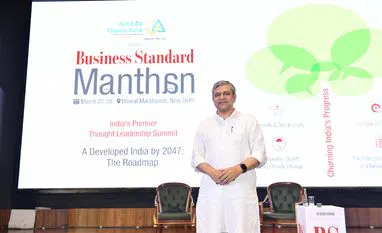
Union Minister Ashwini Vaishnaw on Wednesday said that in Prime Minister Narendra Modi's next term, India would become a product nation and many of these products will come from deep tech.
"Mark my words, India will become a product nation and many products will come from deep tech sectors which will affect every citizen's life," he said at the Business Standard Manthan, in a fireside chat with Nivedita Mookerji, executive editor of the newspaper.
The Minister for Railways, Communications and Electronics and Information Technology also said that the Centre would create a policy framework for the Global Capability Centres (GCCs).
"We will create a major policy framework for the GCCs which are set up here and build on that strength," he said adding that the focus of the government is equally on manufacturing as well as services because "both of them are hugely employment opportunity".
Vaishnaw added that regulations need to be imposed on social media platforms. He said that unlike in the 1990s when the internet was limited and there was no liability of the content provider, now its responsibility has to be taken by the platforms.
"And that is a global consensus which is forming among all the communication and digital ministers that I've met in the last two and a half years," he said.
"Platforms have to take responsibility."
Vaishnaw also said that India has three competitive advantages in the semiconductor business.
One, it has talent which is already designing high-end chips. Second, India has taken big strides in having clean energy.
"Today, the world is actually amazed that we have close to 42 per cent of our power generation capacity as green power," he said.
The third advantage is that there is a large chemical and gas handling ecosystem in Dahej in Gujarat. "It is among the top few chemical ecosystems in the entire world," he said.
"There are very few countries which have these kinds of competitive advantage," he said.

 "India will become a product nation in PM Modi's next term: Vaishnaw")

