World Ozone Day 2025: Why the ozone hole matters and India's plan to act
First identified in 1987, the International Day for the Preservation of the Ozone Layer is being celebrated on Tuesday, September 16, 2025, with the theme "From science to global action"
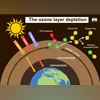
Sonika Nitin Nimje New Delhi Ozone, sometimes known as the "Earth's Umbrella," shields our planet from intense UVB rays. The ozone hole, on the other hand, is the outcome of human activity-induced ozone layer depletion. The Vienna Convention for the Protection of the Ozone Layer was signed by 28 nations on March 22, 1985, as a result of the scientific evidence of the ozone layer's depletion prompting the international community to establish a system for collaboration to take action to safeguard it.
This year, the ozone hole in Antarctica has grown to a size of 20 million square kilometers. Despite being larger than usual, NASA's Ozone Watch reports that it is within the typical range observed in this decade.
World Ozone Day 2025: Date and theme
World Ozone Day will be observed on Tuesday, September 16, 2025, according to the United Nations' official website. On this day, the Vienna Convention, a historic pact that established the framework for ozone layer protection, celebrates its 40th anniversary.
"From Science to Global Action," this year's theme, focuses on how decades of research and international collaboration made the fight against ozone depletion a worldwide success.
The United Nations claims that the Montreal Protocol is essential to this narrative. Along with phasing out CFCs and related substances, the Kigali Amendment broadened its focus to include reducing hydrofluorocarbons (HFCs), which are potent greenhouse gases that contribute to climate change but do not damage ozone.
Why worry about Ozone Hole today?
By encouraging alternatives for CFCs and HFCs, the Montreal Protocol has significantly contributed to the reduction of ozone depletion. The impacts of the current depletion are still substantial even though it falls within the usual range. According to Dr. Gopichandran, the Montreal Protocol has prevented a 0.5C increase in global temperatures, 135 gigatonnes of carbon dioxide emissions, and two million cases of skin cancer annually.
But there are new difficulties. Injecting aerosols into the stratosphere may aid in cooling the Earth's surface, but it also causes more ozone to be lost. The effects are not limited to people. Ozone depletion has changed the habitat of phytoplankton, which are single-celled creatures that dwell close to the ocean, river, and sea surface, in the Arctic.
How the Indian government is planning to reduce 'ozone layer depletion' for future generations?
The Indian government's main initiatives to prevent future ozone layer depletion are the advancement of its comprehensive India Cooling Action Plan (ICAP) and the implementation of its national strategy for phasing down powerful hydrofluorocarbons (HFCs) under the Kigali Amendment.
These programs expand on India's prior achievements in the phase-out of other ODS, such as hydrochlorofluorocarbons (HCFCs) and chlorofluorocarbons (CFCs). International collaborations include:
• Compliance with the Montreal Protocol: In order to fulfill its responsibilities under the Montreal Protocol and its Kigali Amendment, India is still collaborating closely with international organizations such as the United Nations Environment Programme (UNEP) and the United Nations Development Programme (UNDP).
• Monitoring and reporting: The government's Ozone Cell is in charge of keeping tabs on developments and informing the Multilateral Fund of the Montreal Protocol of India's successes in phase-out of ODS.


 "World Ozone Day 2025: Why the ozone hole matters and India's plan to act")

