


Home / Companies / Interviews / Second wave of digital adoption to be more powerful, says TCS top brass
Second wave of digital adoption to be more powerful, says TCS top brass
'Last quarter, we added about four clients in the $100-million list and had more than 989 customers who gave us business of more than $1 million in the last 12 months'
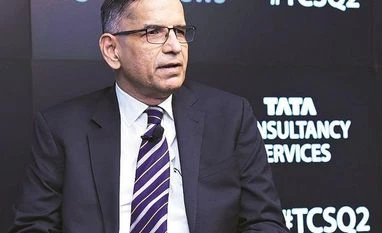 "V Ramakrishnan")
premium
V Ramakrishnan, Chief Financial Officer at TCS
Last Updated : Oct 15 2018 | 12:30 AM IST
Tata Consultancy Services (TCS) once again delivered a strong set of numbers for the second quarter ended September 30. While showing two consecutive quarters of double-digit revenue growth (in $ terms), the company exuded strong faith in continuing this rate. In an interview with Romita Majumdar and Bibhu Ranjan Mishra, the Mumbai-headquartered company’s Chief Operating Officer N G Subramaniam and Chief Financial Officer V Ramakrishnan talk about the factors behind such optimism. Edited excerpts:
N G Subramaniam:
Other than the seasonality in the third quarter (Q3), do you foresee any other headwind?
Q3 usually has a number of festivals with fewer working days. Seasonally, it's a weak quarter with subdued growth. IT budgets also tend to finish towards the end of the year for most customers, which means they won't take any new investments decision until finishing the budget. Some clients use this opportunity to shut down their plants for annual maintenance, which employees go on extended holidays.
There are concerns regarding hard landing of Brexit along with continuing trade war. As a company, you have huge exposure to the UK and European region. How do you expect it to pan out?
It (Brexit) will happen, but in what form is still under debate. Whatever happens, either way, there will be changes to a number of systems and technology adoption. The way I see it there will be opportunities from both the UK and European side. Internally, we also have to change our systems for compliance regulations and travel restrictions, among others. In Europe, they are looking at strengthening the ‘one Europe’ concept while investing in ‘one digital Europe’. Overall, there will be changes to technology areas in many places, both government and industry, which will create opportunity for us.
In terms of geographic split, you have a good presence in Europe, especially in the UK. Do you have any specific plan to expand in Continental Europe? Will you look at expanding in those geographies?
In Continental Europe, we have been present for quite some time. Our presence in Germany and France dates back to over 25 years. We have also invested in these geographies through delivery centres. We recently opened a delivery centre in Paris and acquired Alti in France. These investments are paying off. France and Germany are growing in their own rights. In Germany, for example, we are doing business at an annual rate of more than half a billion alone. The future looks good (in this region).
Even though the growth in digital has been pretty strong, in the traditional or legacy business, it's tepid. How do you plan to speed up?
We have stated that digital adoption is imminent. Initially, in the digital space, people were largely looking at creating apps and changing the front-end like internet banking. However, in the second wave, backend core also needs to be changed to leverage analytics and other technologies to give greater customer experience. The core needs to be moved to Cloud. As we do that, the traditional investments in backend will be classified as digital. Till then, digital share will continue to grow but at some point, everything will become digital.
Is it the same sales team at the front-end who are selling digital services as well, or have you approached in differently?
We have trained all our existing sales team through a massive retransformation programme to haunt for digital opportunities. We have also come up with a “machine-first” delivery model. For example, if a customer wants infrastructure services, how do you bring in the approach? While we continue to provide infrastructure and application services, the machine-first approach will provide automation or Cloud, etc, at the core of these services.
It's a question of realistically migrating the existing services into a new way of working. Our customers like it.
V Ramakrishnan:
V Ramakrishnan:
V Ramakrishnan, Chief Financial Officer at TCS
Last quarter, TCS was able to add a good number of clients, including some large ones. Is client mining also improving for the company?
I think the overall demand environment is driven by what technology can do to businesses. Last quarter, we added about four clients in the $100-million list and had more than 989 customers who gave us business of more than $1 million in the last 12 months. That number has also gone up. What is important is there has been a movement across revenue bands, and it shows that we are able to deeply mine existing customer relationships and are able to give them the full breadth of services that we have.
In the management commentary, TCS has indicated that there are still some 'structural issues' in the retail sector. What are these?
There has been a lot of financial and management changes in many of the client organisations in this sector. Moving from a corporate-listed entity to private equity hands are among the many corporate actions that have taken place. So, some of them have been going through financial stress. It is more pronounced in the US than in other markets.
Other than depreciating rupee, TCS also saw an improvement in margins owing to operational efficiency. What are these measures?
It is across the P&L. From planning and executing projects to use of all the levers for financially efficient project execution, it includes all. It also includes how you negotiate your contracts, what you get from your customers as well as how you plan your delivery to complete it within the target. There are also efficiencies like traditional levers such as productivity improvement, employee utilisation and use of technologies. This is a continuous process. In Q1FY19, our margins got 70 bps benefits from operational efficiencies. It was 30 bps this quarter. We continue to look at every area that we can improve to ensure that there is no inefficiency and wastage.
Some of the IT contracts being signed are also coming with a 'rebadging' clause wherein you are acquiring the employees of the client that is giving you works. Is it not an added pressure?
Insourcing or rebadging is happening in specific context and not across the board. Many of these engagements are where you are delivering an outcome based on resources. These type of insourcing also happens when you take over the client's application stack or IT infrastructure. For instance, many transformational deals in the insurance space, we are running their entire operations. While that transformation takes place, you still have to run the services and operations, for which you need these people.
Is there going to be any change in your inorganic growth strategy?
Last few years, we have not done any major acquisitions. No doubt, we are continuously looking at it. It is something which is very much our focus area. But we have largely built a lot of our capabilities organically and we believe that has delivered good outcome for us.