Company sources said that the railway ministry has created a Rs 4.17 billion package as part of the budgetary provision for Burn Standard and based on this, the resolution professional had proposed the plan to NCLT.
While the plan has been accepted by current employees who fear the company, which traces back its origin to 1781, may be closed down by the railway ministry, former employees have contested the resolution plan terming it as "arbitrary and illegal".
According to Anutosh Bandyopadhyay, president of Burn Standard Ex-Officers Welfare Association (BSEOWA), the resolution professional didn't submit the plan to the former employees, who are a party to the case in NCLT.
Furthermore, he alleged that the plan doesn't include payment of dues and arrears to the former employees, which is estimated at Rs 1.5 billion.
Citing legal decisions taken in 2002, Bandyopadhyay claimed that the Pay Commission recommendations of 1992 and 1997 haven't been implemented and has led to arrears and other dues piling up.
"The order (from NCLT) is unlawful and ignores decisions taken by the Calcutta High Court in February 2002. We are moving a petition to the President of India apprising him about the legality of the judgement and will then appeal to NCLAT to overturn the decision taken today (March 6, 2018)", he said.
The company was referred to the NCLT by its own board after the Sick Industrial Companies (Special Provisions) Act, 1985, was repealed in late 2016. Former employees were a party to the process since the inception of the resolution process.
With an accumulated loss of Rs 2.84 billion and a negative valuation at Rs 1.07 billion, Burn Standard Company has been able to churn Rs 1.97 billion as its revenue during the nine months ended December 31, 2017.
A source said that while filing its report to the NITI Aayog, the railway ministry had stated Burn Standard Company as a unit of strategic importance as it can make coaches and wagons with capability to manufacture new designs, can build most of the components needed by the railways and can quote cost-effective prices while bidding in tenders.
However, NITI Aayog had suggested closure of this sick public sector undertaking and the matter is under ministerial consideration.
1781 - Burn & Co founded in Kolkata
1828 - Construction business of Burn & Co taken over by Martin & Co
1918 - Indian Standard Wagon founded in Kolkata
1950s - Burn & Co diversifies into railways engineering
1976 - Burn & Co nationalised. Amalgamated with Indian Standard Wagon to form Burn Standard
1987 - Burn Standard Co placed under BBUNL
1995 - Declared sick, Burn Standard referred to BIFR
2010 - Company's ownership shifts from BBUNL to the Railways Ministry
June 2017 - Burn Standard board refers itself to NCLT after Sick Industrial Companies (Special Provisions) Act, 1985 gets repealed in 2016
13 February 2018 - Resolution professional (RP) fails to come up with resolution package. Gets extension.
26 February 2018 - RP submits Rs 4.17 billion resolution plan before Kolkata Bench of NCLT
6 March 2018 - NCLT Kolkata Bench approves plan. Ex-officers' association plans to move Court against judgement


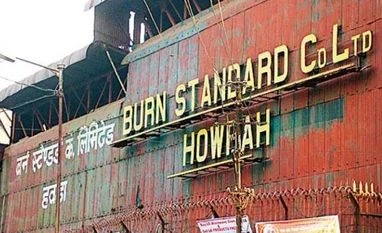 "Burn Standard")