


'Mad Queen' : The treatment of Mother of Dragons was sexist in GoT
'Dany' is making tragic choices that all political leaders face when it comes to using violence to achieve their goals. But the writers chose to show her as acts as irrational, tyrannical or insane.
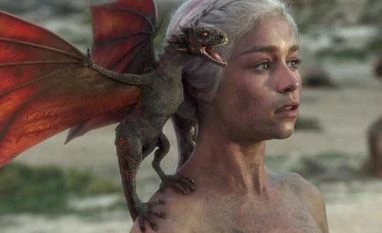 "Daenerys Targaryen")
File photo of Daenerys Targaryen (Emilia Clarke) in one of the early episodes of Game of Thrones


Game of Thrones has ended, and all is well — especially with the long-suffering Starks of Winterfell.
Arya has forsaken revenge and is off to explore new lands, Jon Snow is back in the true north with his faithful direwolf, Ghost, Sansa is the Queen in the North for a newly independent realm and Bran the Broken is the near-omniscient ruler of the Six Kingdoms. Westeros is truly the land where dreams come true.
Of course, there is the small matter of why Jon is back with the Night’s Watch — he murdered his lover, queen and aunt, Daenerys “Dany” Targaryen, the self-proclaimed Mother of Dragons who had finally just reconquered her family’s ancestral throne.
This incident (so traumatic to Dany’s fans) was justified in the show when Tyrion convinced Jon that Dany was now a crazed dragon-riding tyrant (apparently inheriting this touch of insanity from her father, the Mad King), who needed to be assassinated after she burned much of King’s Landing to ashes in the penultimate episode.
And really, the writers didn’t need Tyrion’s speech to make this point, given they’d just depicted Dany as a Disney villain (Maleficent) by framing her in front of her dragon’s outstretched wings while giving a Triumph of the Will-style pep talk to her troops.
It’s tempting to go along with this notion of Dany as Mad Queen, and accept the good feelings that accompany the triumph of the righteous Starks. But what if, instead, Dany is the real heroine of the series, and Jon is the real heel?
Much of the case against Dany depends on the supposed insanity that fuelled her destruction of a city, but I offer another perspective — drawn from Renaissance political thinker Niccolo Machiavelli — to explain why Dany is not “mad” at all, but rather an avatar of cold-blooded realpolitik.
Hardly a ‘crazy lady’
This may be disturbing, depending on your view of power politics, but it isn’t unearned (her development had been long signalled), nor is it a sexist reduction of one of the greatest female characters ever to an emotional, irrational, “crazy lady.”
Dany is making the tragic choices that all political leaders face when it comes to using violence to achieve their goals. What’s disturbing, however, is that show runners David Benioff and D. B. Weiss chose to depict her acts as irrational, tyrannical or insane.
Even her fans were upset that instead of bringing liberation from the cycle of rich oppressing poor (“breaking the wheel” as Dany phrased it), she used her dragon to immolate most of the capital, even after the symbolic tolling of bells that indicates surrender.
And since she does this in the wake of losing two of her dragon “children,” her two best friends (Jorah and Missandei), and then being rejected romantically by Jon Snow (who is really a Targaryen and also her nephew), many saw her fiery actions as a response to psychological trauma, and the writers seemed to confirm this in the final episode.
Critics pointed out that yet again, we see a powerful woman who simply can’t handle her emotions, and who becomes the “Mad Queen” in a clichéd turn to villainy that can only be explained by her losing her mind. But is destroying a city the act of a crazy woman? Not necessarily, says Machiavelli. While it may be evil, there is a calculated reason for Dany’s decision to rain fire from the sky.
New princes, old problems
Dany confesses her dilemma to Jon privately in terms that echo Machiavelli’s 1513 The Prince, when he discusses the problems a “new prince” faces when conquering a country.
She says: “I don’t have love here. I have only fear,” referring to the affection that the people of Westeros hold for Jon Snow (who is actually the true heir to the throne, but who doesn’t want to rule). And after Jon rejects her romantic advance, and by implication the possibility that they could marry and unite the realm using both love (of the people for him) and fear (of her army and dragon), she says simply: “Let it be fear.”
Machiavelli saw the basic problem of ruling in exactly these terms. In Chapter 17 of The Prince he asks whether love or fear is more important to a ruler, and concedes that while having both is best, at the end of the day, fear is the option to depend upon: