


When Donald Trump met NATO: Blunt talk and meaningful silences
Since 1949, NATO has been a bedrock of American foreign policy
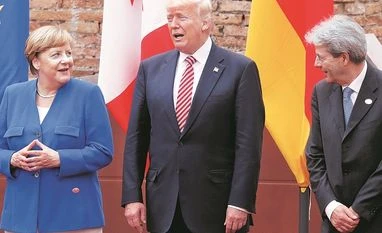 "US President Donald Trump (centre), Germany’s Chancellor Angela Merkel (left) and Italian Prime Minister Paolo Gentiloni at the G7 summit in Taormina, Italy, on Friday. Photo: Reuters")
US President Donald Trump (centre), Germany’s Chancellor Angela Merkel (left) and Italian Prime Minister Paolo Gentiloni at the G7 summit in Taormina, Italy, on Friday. Photo: Reuters
Donald Trump’s electoral campaign was notable for his abrasive statements and blunt assessments about a variety of issues. Among his more unforgettable claims was his suggestion that NATO was “obsolete.”
This comment was largely founded, it seems, on a lack of understanding about what NATO does or how it functions. Since 1949, NATO has been a bedrock of American foreign policy, first in Europe against the Soviet Union and its allies, and then in Afghanistan. Trump’s desire to build bridges with the Russians, and his plain ignorance about NATO’s contribution in the war against the Taliban, largely explains his startling claim.
But what interests me as a keen observer of NATO politics is what Trump’s encounter with the other NATO leaders reveals about their relationship. And what will he claim about that meeting on his return?
A reeducation
As in many other policy areas, some quick tutoring led Trump to completely reverse his position. Key to that education was undoubtedly Defense Secretary James Mattis, who reportedly told the German defense minister soon after Trump’s inauguration that NATO remained the “central pillar” of transatlantic security and commented in congressional testimony that Russia remained America’s number one security threat.
So Mattis himself, Vice President Mike Pence and Secretary of State Rex Tillerson all traveled to Europe in the first 100 days of the Trump administration to reassure NATO allies about the organization’s continued importance. This sentiment was reinforced by General Curtis M. Scaparrotti, the current supreme allied commander Europe.
By April, Trump had issued a predictably blunt edict in which he reversed course: “I said it was obsolete. It is no longer obsolete.”
Still, for many of us, a subsequent visit to see those we’d publicly criticized would be awkward. But just like his meeting with Pope Francis, Trump again demonstrated an amazing capacity to shrug off his earlier statements without any outward sign of embarrassment – while simultaneously asserting an authoritative tone.
The discussions in Brussels may have been more symbolic than substantial. But Trump’s ability to assume a claim of leadership – and success – was helped by two developments.
Claiming a victory on NATO financing
First, Trump chastised other NATO members, reiterating his demand that they contribute more to NATO’s common defense.
Since the end of the Cold War, the size of the U.S. defense budget has varied, but expenditures always stayed above 2 percent of GDP. At the same time, however, most European budget expenditures haven’t. At NATO’s 2014 summit, NATO members agreed to target spending 2 percent of their GDP on defense.
Of the 27 other NATO members, only four currently meet the threshold. And of those, only Britain has a substantial military capability. Most pointedly, Germany has significantly underspent on defense. The fact that the 2 percent threshold doesn’t formally have to be met until 2024 is one of those minor facts that Trump conveniently ignores.
But this issue has been a longstanding squabble. In a rare example of bilateral consensus, Trump echoed the sentiment of both Barack Obama and Hillary Clinton in demanding that they pay more. And, he added,