Bimal Gurung, leader of the Morcha and chief executive of the Gorkhaland Territorial Administration (GTA), which has the partial autonomy to run Darjeeling's administration, led the protest.
Gurung made the headlines in 2007, when he started the new Gorkhaland Andolan after Gorkha National Liberation Front (GNLF) supremo Subhash Ghisingh was evicted from power. Gurung, who piggybacked Indian Idol III Prashant Tamang , a Kolkata Gorkha policeman and the only Nepali to win the singing contest in 2011 , galvanised all Indian Gorkhas to help them discover their common identity.
Indian Gorkhas are distinct from Nepali Gorkhas and are scattered all over the country, notably in J&K, Himachal Pradesh, Uttarakhand, North Bengal, Sikkim, the Dooars, and the North-East. Like Israelis once, they are in search of a homeland. Perception differences and government policy have simultaneously blurred and accentuated the identity crisis. They see Banerjee as a big threat to this identity.
Gurung is the undisputed leader of the GJM in an area that has the largest concentration of Indian Gorkhas — Kurseong, Kalimpong, Darjeeling, and parts of the Dooars. It has a Gorkha population of nearly 2.2 million compared to 600,000 in Sikkim, which became a state in 1975 following Indian annexation.
The region is of great strategic value. It is contiguous — or nearly contiguous — to four countries — Nepal, China, Bhutan, and Bangladesh. The vulnerable Chicken’s Neck and the Siliguri Corridor and the National Highway 31 A to Sikkim, along with the only road and rail links to the North-East along the Tiger and Sevok bridges, lie in this area.
Although Ghisingh started the Gorkhaland movement in the 1980s, he left behind a legacy riddled with corruption and tarnished with the charge of sleeping with the enemy — West Bengal. Gurung was the chela who overtook the guru. He is determined and tough, and sounds just a little bit like Hitler in his style of oratory. Gurung is, right now, worth his weight in gold to the BJP, which is trying hard to make inroads in West Bengal. By all accounts, the GJM is a well-knit organisation and hugely motivated. The 30,000 ex-servicemen, together with a growing students’ wing, make a powerful team. It was Gurung who sent Jaswant Singh to the Rajya Sabha from Darjeeling, and, later, got S S Ahluwalia elected.
The TMC sees Gurung as a rival and a roadblock. But Gurung is going nowhere — as long as he has the BJP by his side. The Darjeeling hills, he reckons, are his so long as the cry of ‘Aayo Gorkhali’ reverberates. The TMC is equally clear that the GJM has to be unseated. It is in this struggle that Gurung’s politics thrives.


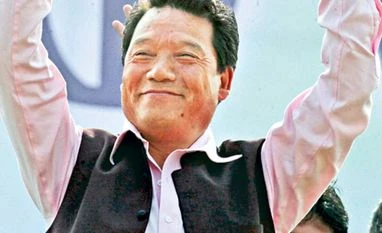 "Meet Bimal Gurung, Hitler of the Hills")