


SC receives plea against Delhi's old vehicle scrapping policy. Key details
The petition argued that the scrapping regulations are being imposed without assessing the vehicles' actual emissions or mechanical condition, leading to unnecessary difficulties for their owners
 "vehicle scrap, car")
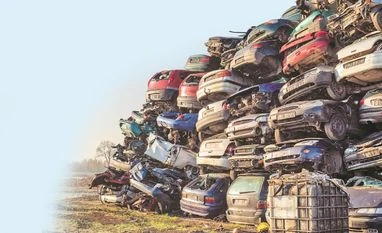
Representational image


Listen to This Article
The Supreme Court received a petition on Thursday (September 19) challenging the Delhi government’s mandatory policy to scrap older vehicles.
Nagalaxmi Laxmi Narayan has contested the 2024 guidelines titled Handling End of Life Vehicles in Public Places of Delhi, which require the compulsory scrapping of diesel vehicles over 10 years old and petrol vehicles older than 15 years, regardless of their condition or roadworthiness.
“The retrospective application of the guidelines to vehicles is arbitrary, violates the applicant’s (Narayan) legitimate expectation, and deprives the applicant of their right to property under Article 300A of the Constitution,” the plea stated.
Scrapping policy criticised for lack of consideration
The petitioner further argued that the scrapping regulations are being imposed without assessing the vehicles’ actual emissions or mechanical condition, leading to unnecessary difficulties for their owners. The plea also mentioned that enforcing this scrapping policy contradicts the terms under which the vehicles were initially purchased. It advocated for the guidelines to be applied prospectively and called for compensation to be provided to those from economically weaker sections affected by the policy.
Such measures, according to Narayan, would not only protect the environment but also ensure that well-maintained vehicles are allowed to stay on the roads.
Also Read

 "Stanford University")
 "The Oberoi Beach Resort, Al Zorah")
 "Adani Enterprises, Adani group")
 "pagers explosion")
 "Abortion")
What is Delhi’s old vehicle scrapping rule?
In February this year, the Delhi Government introduced updated guidelines for managing end-of-life vehicles in public areas. The rules include imposing fines of Rs 10,000 for impounded four-wheelers and Rs 5,000 for two-wheelers, which must be paid before the vehicles can be released.
The guidelines call for continuous enforcement campaigns to eliminate outdated vehicles from public spaces across the national capital. Daily reports of these enforcement actions are submitted to the Environment Department, which forwards them to the Commission for Air Quality Management.
The government has also created two categories for releasing impounded vehicles: one for owners wishing to move their vehicle outside Delhi-NCR and another for those who intend to store the vehicle in private spaces that are not part of shared parking areas.
What are the penalties on impounded vehicles?
The guidelines specify that once a vehicle has been impounded for being an end-of-life vehicle (ELV), it can be released upon the submission of an undertaking that it will not be driven or parked in any public area within Delhi. Additionally, it must be relocated out of the city.
For four-wheelers, a fine of Rs 10,000, along with towing and parking fees as per the Delhi Maintenance and Management of Parking Places Rules, 2019, must be paid before release. Two-wheelers face a Rs 5,000 penalty plus towing and parking fees.
A second impoundment of an ELV or diesel transport vehicles over 10 years old would result in the vehicle’s non-release.
Vehicles that are impounded may be scrapped if the application for release is not submitted within three weeks if the release request is rejected, or if the vehicle is impounded for a second time. The scrap value will be credited to the vehicle owner’s bank account within 15 days, and all transactions will be processed digitally.
More From This Section
 "Rain, Rainfall, monsoon, New Delhi Rain")
 "Supreme Court, SC")
 "West Bengal Chief Minister Mamata Banerjee interacts with junior doctors delegation, at her Kalighat residence in Kolkata on Saturday. (PHOTO: PTI)")
 "Crime")
 "Delhi Rains, Rain")
Don't miss the most important news and views of the day. Get them on our Telegram channel
First Published: Sep 20 2024 | 11:39 AM IST