


Centre expects record 115.43 mn tonnes wheat output in 2024-25 rabi season
At present, wheat prices in the Delhi mandis are ruling at around ₹3,000 per quintal, almost 24 per cent higher than the minimum support price (MSP) of ₹2,425 per quintal
 "wheat,agriculture")
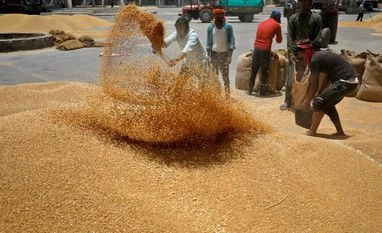
Presently, wheat prices in the Delhi mandis are ruling at around Rs 3000 per quintal which is significantly higher (almost 24 per cent higher) than the Minimum Support Price (MSP) of Rs 2425 per quintal. (Reuters)
Listen to This Article
Wheat production in the rabi season of 2024-25 is expected to be a record 115.43 million tonnes on account of strong acreage and favourable weather, according to the second advance estimates, released on Monday.
Higher than expected output could go a long way in bringing down the high wheat price, the inflation rate for which has risen from 6.02 per cent in April 2024 to 8.80 per cent in January 2025.
At present, wheat prices in the Delhi mandis are ruling at around ₹3,000 per quintal, almost 24 per cent higher than the minimum support price (MSP) of ₹2,425 per quintal.
A good wheat crop will help the government in replenishing its inventories, which as on February 1 were close to 16.1 million tonnes, as against the January 1 buffer requirement of 13.8 million tonnes.
It might even open the door for resuming wheat export if prices in the domestic market cool enough.
The government needs to maintain a wheat buffer of around 7.5 million tonnes on April 1 each year.
Also Read

 "Doctor, Medical, Health care")
 "Ayushman Bharat , PMJAY")
 "SC, Supreme Court")
 "Fiscal deficit")
 "Kejriwal, Arvind Kejriwal")
In FY25 and FY24, the opening stock of wheat in government inventories was precariously close to the buffer requirement at 7.5 million tonnes and 8.4 million tonnes, respectively.
In Fy-26 start, it is expected to remain at around 10-11 million tonnes.
Not only that, the government’s own wheat procurement has been falling short of the target for some years because farmers are preferring selling their crops to private traders for better prices rather than opting for official procurement.
Lower than targeted procurement has crimped the government’s ability to intervene in the market effectively to cool prices through open-market sale.
In FY25, the government managed to pump close to 3 million tonnes into the market. Open-market sales in FY24 were close to 10 million tonnes.
This has also resulted in prices remaining high.
A good wheat crop would mean that Centre might be able to reach its targeted FY26 procurement of around 32 million tonnes.
The Madhya Pradesh and Rajasthan governments have announced a bonus of ₹125 and ₹150 per quintal, which has taken the effective minimum support price close to ₹2,600 per quintal as against the official ₹2,425.
One objective of the bonuses is to meet the procurement target.
Madhya Pradesh this season has targeted procuring around 8 million tonnes. Rajasthan’s target is less than that.
The data shows that among other major rabi crops, mustard output is estimated at 12.87 million tonnes, marginally lower than the 13.26 million tonnes last year.
The fall is due to shift in acreage to wheat and chana because farmers could not get adequate prices for oilseeds in the just preceding kharif season.
The production of chana is estimated at 11.53 million tonnes, up from the 11.04 million tonnes last year.
Chana is the largest variety of pulses grown in the country and any surge in output has a cascading impact on prices.
The second advance estimates also showed foodgrain production in the country -- kharif and rabi combined -- is expected to be around 331 million tonnes, slightly lower than the 332.3 million tonnes last year.
“The production of rabi crops is based on average yields. Hence these figures can change in successive estimates,” an official statement said.
More From This Section
 "wheat,agriculture")
 "agriculture, farmers, crops, farming")
 "pulses")
 "cooperative sugar mills and boost ethanol production")
 "trade")
Don't miss the most important news and views of the day. Get them on our Telegram channel
First Published: Mar 10 2025 | 8:46 PM IST