


Transformers and Rectifiers tanks 20%; why smallcap stock hit 52-week low?
Transformers and Rectifiers delivered a lackluster performance with decline in profitability and the soft performance may push the company's growth plans, fear analysts at ICICI Securities.
 "Transformers and Rectifiers forms JV with China's Jiangsu Jingke")
Listen to This Article
Share price of Transformers and Rectifiers (India) today
Shares of Transformers and Rectifiers (India) (TARIL) were locked at the 20 per cent lower circuit at ₹314.20 on the BSE in Monday’s intra-day trade in an otherwise firm market after the company reported a weak set of numbers for the second quarter of the financial year 2025-26 (Q2FY26).
Till 09:29 AM; a combined 2.4 million equity shares changed hands and there were pending sell orders for 930,000 equity shares on the NSE and BSE. In comparison, the BSE Sensex was up 0.15 per cent at 83,339.
The Transformers and Rectifiers stock price hit a 52-week low today, falling below its previous low of ₹355.15 touched on March 4, 2025. It has more-than-halved or tanked 52 per cent from its 52-week high of ₹650.23 hit on January 8, 2025.
TARIL’s Q2 results
TARIL reported a disappointing set of earnings for the quarter ended September 2025 (Q2FY26). Revenue came in flat year-on-year (YoY) at ₹460 crore. Earnings before interest, tax, depreciation and amortisation (EBITDA) and profit after tax (PAT) margins declined 380 bps and 180 bps YoY to 11 per cent and 8 per cent respectively on sticky employee costs. Consequently EBITDA and PAT declined 26 per cent and 19 per cent YoY to ₹52 crore and ₹37 crore respectively. In Q2FY25, the company had posted EBITDA of ₹80.97 crore and PAT of ₹46.02 crore.
The company received orders worth ₹592 crore in Q2 taking the order backlog to ₹5,472 crore (₹5,246 crore Q1FY26). The company has further bid prospects of ₹18,700 crore.
Also Read

 "Trent, westside, fashion retail")
 "bajaj auto shares in focus after Q2")
 "cement, cement sector")
 "Paytm")
 "L&T Finance commercial paper fundraising, L&T Finance liabilities 2025, easing interest rates India, RBI liquidity measures 2025, Sachinn Joshi L&T Finance, short-term borrowing trends India, CP market India 2025, repo rate cut expectation India, L&T")
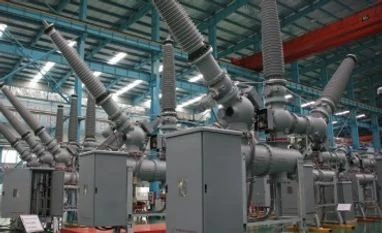
TARIL is a prominent player in the manufacturing of transformers & reactors in India. TARIL operates on a B2B model, catering to power generation, transmission, distribution, & industrial sectors. The company has an installed capacity across units of ~40,000MVA.
ALSO READ | Bajaj Auto gains on multiple stock upgrades post Q2 results; outlook here
ICICI Securities view on TARIL
TARIL delivered a lackluster performance with decline in profitability. The soft performance may push the company's growth plans. However the company has a decent order book of ₹5,472 crore and further bid prospects of ₹18,700 crore.
Going ahead, the company needs to significantly improve order execution and order intake. Its focus on improving operational efficiency, sustainable working capital cycle and capacity expansion will enable TARIL to capture opportunities from augmentation of transmission infrastructure in the country, the brokerage firm said in its note.
India Ratings and Research (Ind-Ra) rationale on TARIL
Ind-Ra in its June 2025 rating rationale said that it understands that the demand cycle is supported by strong traction in multiple segments, primarily renewable energy, and industrial demand while green hydrogen is also emerging. The government of India’s massive target to install 500GW renewable power by 2030 has necessitated the development of major intra- and inter-state transmission grids for power distribution from renewable energy zones. The company with its ongoing capacity expansion and strong balance sheet is poised to benefit from the strong industry cycle.
ALSO READ | Trent slides 6% to lowest since June 2024 on weak demand after soft Q2
However, TARIL’s business operations are capital intensive due to several reasons. The customised nature of orders leads to high work-in-progress days. Furthermore, at times raw material is procured in bulk due to cost efficiency and import lead times, adding to inventory carrying days. On the sale side, while 80 per cent-90 per cent payment is received on supply and testing, the balance is retained by customers till satisfactory performance timelines of over a few months.
A decline in the EBITDA along with an elongation of the working capital cycle and/or significant debt-funded capex, resulting in deterioration in the liquidity and net leverage (including acceptances) remaining above 2.0x, on a sustained basis, could be negative for the ratings, the rating agency said.
More From This Section
 "Stock Market LIVE Updates")
 "Asian stcks, asian shares, share market")
 "Rs, Rupee, Indian Currency, 20 Rs, Economy")
 "Stock Market")
 "Tata Motors demerger")
Topics : The Smart Investor Transformers and Rectifiers (India) Q2 results stock market trading Market trends
Don't miss the most important news and views of the day. Get them on our Telegram channel
First Published: Nov 10 2025 | 10:04 AM IST