


The making of brand Shashi Tharoor
The story of the man who makes you open a dictionary before breakfast is a masterclass in accidental differentiation
 "Shashi Tharoor, Shashi, Tharoor")
premium
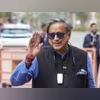
Mr Tharoor’s brand lesson is simple: In a cluttered market, don’t try to be louder in the same language. Try to be different in a language only you can own (Photo:PTI)
5 min read Last Updated : Oct 09 2026 | 11:40 PM IST
Listen to This Article
In India, there are two types of politicians. Type A: Those who rabble-rouse and make you clap or cry. Type B: Those who make you scratch your head and think. In a fun kind of way.
Shashi Tharoor single-handedly created Type B. And then made Type B more famous than Type A.
Ten years ago, he was a second-rung Congress MP from Thiruvananthapuram, known in Lutyens’ circles as “that UN guy who almost became Secretary General”. Respected, erudite, but not exactly someone your driver would discuss. Today, your driver knows him. Your cook knows him. Your 16-year-old knows him because he had to Google “sesquipedalian” after Mr Tharoor posted it on social media.
How did a diplomat with Oxford English become a mass brand in a country that loves three-word slogans? That’s Brand Tharoor. And it’s a masterclass in accidental differentiation. Mr Tharoor’s brand started in failure.
In 2006, he was India’s candidate for United Nations Secretary General. Shashi Tharoor vs Ban Ki-moon. He lost. Mr Tharoor should have won — suave, brilliant, author of five books, perfect UN English. But he didn’t. Most others would have retired to write columns.
Mr Tharoor did the opposite. He came back to India and joined politics — the one profession in India where good English is usually a disqualification.
In 2009, the Congress gave him Thiruvananthapuram. He won. Became minister of state for external affairs. Then came the first tweet that almost ended him. “Will travel in cattle class in solidarity with holy cows.” Talking about economy class. India erupted. In 2009, Twitter (now X) had 200,000 users in India. All of them were outraged. The headlines screamed: “Tharoor insults economy class passengers, calls them cattle.” He apologised.
But the brand was born — the English-speaking, slightly elitist, very witty man. Brand Tharoor pivoted from politician to phenomenon.
The real launch of Brand Tharoor was not a speech. It was a word. In July 2017, he tweeted: “Exasperating farrago of distortions, misrepresentations and outright lies.” India stopped. News anchors who had never used the word “farrago” in 20 years had to say it 20 times that evening. Memes exploded. School kids asked teachers — “What is farrago?”
And then Mr Tharoor did the smartest thing a brand can do — he owned it. He didn’t say: “Sorry for big words.” He launched “Tharoor’s Word of the Day.”
Farrago. Rodomontade. Sesquipedalian. Floccinaucinihilipilification — 29 letters, meaning the “act of estimating something as worthless”. He used it to describe something as worthless, using a word worthless to estimate worthlessness. Suddenly, every Indian who wanted to sound smart had a new guru. English teachers loved him. Tinder bios started saying: “Looking for someone who understands Tharoor without dictionary.”
This is classic brand differentiation. In a market where every politician was trying to be more desi, more simple, Mr Tharoor went the opposite way — more complex, more English, more Oxford.
Byron Sharp would call it Distinctive Asset. In a sea of white kurta, Hindi slogan sameness, one man in a well-cut suit saying “snollygoster” stands out. You may not like him, but you cannot ignore him.
His English didn’t make him elite. It made him meme-able. In India today, meme-able is electable — at least for mindshare.
From 2017 to 2020, Mr Tharoor became India’s most followed politician after Narendra Modi and Rahul Gandhi, without being Prime Minister, without being chief minister, without a single Hindi slogan. That’s not politics. That’s branding.
He turned vocabulary into virality.
The big words have both built and boxed him. For his fans, the words are proof of erudition. For his critics, the words are proof of elitism.
Mr Tharoor’s brand lesson is simple: In a cluttered market, don’t try to be louder in the same language. Try to be different in a language only you can own.
He didn’t try to out-Modi Modi in Hindi oratory. He didn’t try to out-Rahul Rahul in yatra. He owned English, books, wit — assets no one else could copy.
Second lesson: One distinctive word can be bigger than 100 speeches. Farrago did more for Mr Tharoor than 10 years of parliamentary questions.
Third lesson: Every strength, if overused, becomes your caricature. Mr Tharoor’s English got him famous, but now he has to work twice as hard to remind people he is more than English.
Brand Tharoor is not perfect. But it is lovable. In a country of 1.4 billion where most politicians sound the same, a man who makes you open a dictionary before breakfast has already won.
After all, as Mr Tharoor himself would say — his career is not an exasperating farrago, but a compelling case of rodomontade turned into relevance.
And you just Googled rodomontade, didn’t you?
That's Brand Tharoor.
The writer is chairman of Rediffusion
Disclaimer: These are personal views of the writer. They do not necessarily reflect the opinion of www.business-standard.com or the Business Standard newspaper