


China launches 12 satellites to build world's 1st space-based supercomputer
China kickstarts its ambitious space computing project with the launch of 12 satellites, aiming to rival Earth's most powerful supercomputers with real-time, in-orbit data processing
 "India has more than 100 space technology startups and most were founded in the past five years. It owns 55 active space assets that include communication, meteorological and Earth observation satellites. According to a report by Tracxn, a market inte")
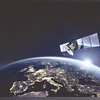
Each of the 12 satellites can handle a staggering 744 trillion operations per second and are interlinked via ultra-fast laser connections capable of transferring data at up to 100 gigabits per second | Representative Picture
Listen to This Article
China has launched the first 12 satellites of its space-based supercomputing network, aiming to outpace Earth’s most powerful systems with real-time, in-orbit data processing.
Twelve advanced satellites, equipped with AI-powered computing systems and high-speed inter-satellite links, were launched into orbit last week aboard a Long March 2D rocket from the Jiuquan Satellite Launch Centre, according to state-run Guangming Daily.
The satellites mark the first phase of China’s groundbreaking Three-Body Computing Constellation – an ambitious space-based supercomputing network led by Zhejiang Lab. Once fully deployed, the constellation will deliver real-time data processing in orbit with a staggering capacity of 1,000 peta operations per second (POPS).
The satellites in the planned 2,800-strong orbital supercomputer, created by ADA Space, Zhijiang Laboratory and Neijang High-Tech Zone, will be able to autonomously collect and process data without the need for terrestrial stations, the company said in a statement.
Three-Body Computing Constellation: How powerful are the satellites?
Also Read

 "In 2019, a team of Google researchers said they had built a machine capable of performing tasks that were not possible with traditional supercomputers. They described this machine, called a quantum computer, as a turning point in the evolution of inf")
 "Ashwini Vaishnaw, Ashwini, Vaishnaw")
 "IndusInd Bank")
 "Securities and Exchange Board of India, Sebi")
 "UP jungle safari vistadome")
Each of the 12 satellites can handle a staggering 744 trillion operations per second and are interlinked via ultra-fast laser connections capable of transferring data at up to 100 gigabits per second, according to Guangming Daily. Together, the initial cluster delivers 5 peta operations per second (POPS) of computing power and 30 terabytes of onboard storage.
Equipped with an advanced space-based AI model featuring 8 billion parameters, these satellites can process raw data directly in orbit. They will also serve as testbeds for cutting-edge technologies, including cross-orbit laser communication and deep-space astronomical observations.
According to the Chinese government, the mission, which marks a major step in China's space-based computing efforts, aims to build a network of thousands of satellites with a total computing power of 1,000 POPS. The constellation will enable real-time, in-orbit data processing to accelerate AI development in space.
AI data centres in space: Power saving
The idea of building AI-powered data centres in space could also offer a promising solution to Earth’s growing climate concerns. The advantages of a space-based supercomputer extend far beyond faster communication, according to the South China Morning Post. Traditional satellites face significant bottlenecks—limited bandwidth and scarce ground stations mean that under 10 per cent of the data they collect ever reaches Earth. But orbiting data centres could revolutionise this process.
As Harvard astronomer and space historian Jonathan McDowell told the outlet, these systems can harness solar power and release excess heat into space, dramatically cutting down on energy consumption and carbon emissions. He added that similar initiatives could soon emerge from the US and Europe.
Global data centres are on track to consume over 1,000 terawatt hours of electricity annually by 2026 – a figure comparable to Japan’s entire power usage – according to estimates from the International Energy Agency.
More From This Section
 "Trump-Putin chat for hours, not even Melania could separate the two")
 "Elon Musk, Tesla CEO")
 "Nusraat Faria, Sheikh Hasina")
 "Hmaas")
 "WHO, World Health Organisation, Bird flu")
Don't miss the most important news and views of the day. Get them on our Telegram channel
First Published: May 19 2025 | 6:32 PM IST