


Musk wins the Twitter war, but Tesla and X are fighting for survival
Elon Musk's business empire is facing mixed fortunes-Tesla's stock has declined, X continues to struggle financially, while SpaceX remains strong due to government contracts and commercial missions
 "Elon Musk, Tesla, X, SpaceX, Twitter")
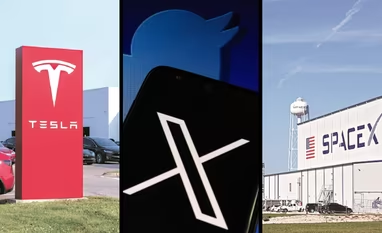
Elon Musk's businesses - Tesla, X, SpaceX company logos | File photo
Listen to This Article
Elon Musk, the world’s richest person, is navigating a challenging period as Tesla’s stock declines, his political ties come under scrutiny, and operational issues pile up at X. While Musk’s political influence continues to grow, his business empire has seen a mix of successes and setbacks as it prepares its entry into India. The US electric carmaker has signed a lease deal to open a 4,000-square-foot showroom in Mumbai and has begun hiring for key positions.
In the past, Tesla and Musk’s other ventures benefited from the enthusiasm surrounding Donald Trump’s re-election, but recent market trends suggest that Musk’s increasing political involvement may now be having unintended consequences.
SpaceX remains strong, bolstered by a steady stream of government contracts and commercial projects. However, Musk’s other ventures are facing significant challenges. Despite his massive $380 billion fortune, Musk has lost over $100 billion in net worth over the past decade, with Tesla’s declining performance contributing to his financial struggles.
Musk reportedly invested $250 million to support Trump’s re-election campaign and later led a cost-cutting initiative within the government called the Department of Government Efficiency (DOGE). While Musk’s appointment as a "special government employee" under Trump has granted him considerable influence over federal operations, concerns are growing about the potential conflicts of interest, particularly in sectors where federal contracts and regulations are key to business success.
Tesla shares plummet
Tesla’s stock had initially surged after Donald Trump’s re-election victory in November but has since lost most of those gains. The company has seen a sharp decline in its stock value, shedding 25 per cent in the past month, 12 per cent over three months, and 28 per cent year-to-date. Although the stock remains up 40 per cent over the past year, the recent 20 per cent slump has pushed Tesla’s market capitalisation below the $1 trillion mark.
Also Read

 "Elon musk, musk, Elon")
 "Elon Musk, DOGE, Tesla CEO")
 "US President Donald Trump")
 "Tesla")
 "Tesla")
Trouble for Tesla began early last year, when sales took a hit amid supply chain disruptions. The company reported first-quarter 2024 deliveries of just under 387,000 vehicles, its lowest in over a year. Production was impacted by multiple setbacks, including Houthi attacks in the Red Sea, which temporarily shut down Tesla’s German factory. The plant was later targeted in an alleged arson attack, further disrupting operations.
Musk also faced pushback from Tesla shareholders over his massive $56 billion pay package last year. READ: This industrialist thinks Elon Musk will not succeed in India. Here's why
One of the biggest setbacks came from China, where Tesla’s “Navigate on City Streets” feature has faced criticism for failing to meet expectations. Reports indicate that Tesla plans to roll out a software update to improve its Autopilot functionality in China, bringing it closer to the Full Self-Driving (FSD) capabilities available in the United States. However, concerns over Tesla’s regulatory challenges in China remain high, especially as the US shifts from a ‘China plus one’ strategy to an ‘Anything But China’ approach, discouraging reliance on Chinese firms.
Tesla’s struggles have further been exacerbated by global trade tensions. The Trump administration’s decision to impose a 25 per cent tariff on Canadian and Mexican goods and a 10 per cent tariff on Chinese imports has triggered retaliatory measures. Canadian officials have suggested a 100 per cent tariff on Tesla vehicles, and Ontario Premier Doug Ford terminated a contract with Musk’s satellite company, Starlink.
Domestically too, the electric vehicle (EV) industry grapples with shifting policy priorities under Trump. One of his first acts after taking office in 2025 was to revoke Biden’s target of 50 per cent EV sales by 2030. Although federal incentives for EVs remain, the administration has frozen funds allocated for EV charging infrastructure, dampening industry growth. Additionally, the Trump administration recently put a planned $400 million US State Department purchase of armoured Tesla electric vehicles on hold. Although the contract had not been awarded to Tesla, it was the sole bidder for the deal.
Critics also argue that Tesla’s product lineup has stagnated compared to new offerings from competitors. Tesla faces stiff competition from traditional automakers expanding into electric vehicles and newer EV-exclusive companies. Key players include BYD, General Motors, Ford, Volkswagen, Rivian, Lucid Motors, and NIO.
BYD, in particular, has emerged as a strong challenger, especially in China and globally, closing the sales gap with Tesla. In the December 2024 quarter, BYD outsold Tesla with 595,413 units compared to Tesla’s 495,570. By the end of 2024, BYD sold 1,764,992 EVs, slightly fewer than Tesla’s 1,789,226. BYD also reported significant sales in early 2025, while Tesla’s sales continue to decline in Europe, with Germany seeing a 70 per cent drop in February. Furthermore, BYD recently announced the inclusion of its “God’s Eye” self-driving technology in nearly all its vehicles. READ: Tesla drives into Indian mkt with showroom in Mumbai's commercial hub BKC
Last year, investors had also voiced concerns over Musk’s divided attention, claiming the tech entrepreneur was more focused on X, his acquired social media platform.
How has X performed under Musk?
Elon Musk’s takeover of Twitter, now rebranded as X, has likely undergone the most drastic transformations. The platform has faced financial turbulence with a significant decline in advertising revenue. Since acquiring the platform for $44 billion in October 2022, Musk has implemented sweeping changes, from mass layoffs to subscription-based revenue models, but X remains far from profitability.
The last time Twitter was profitable was in 2019.
After renaming Twitter to X in July 2023, Musk sought to overhaul the company’s business model, aiming for less reliance on ad revenue and more on subscriptions. However, X has continued to struggle financially. According to WARC Media analysis, the platform’s advertising revenue plunged from $4.5 billion in 2022 to $2.2 billion in 2023—a steep 46.4 per cent decline. Reports predict a further drop to around $2 billion in 2024, with the downward trend likely continuing into 2025.
Much of this decline can be attributed to the exodus of major advertisers. In September 2023, Musk admitted that US ad revenue for X was down by 60 per cent. By December 2023, a report from Media Matters revealed that 50 of Twitter’s top 100 advertisers from 2022, who had contributed $750 million in revenue, had either reduced or entirely halted their ad spending on the platform.
Advertisers have been wary of X’s shifting content policies, including the reinstatement of previously banned accounts and the disbanding of its Trust and Safety Council, which had provided oversight on platform moderation.
However, a report by Bloomberg last month suggested that X may see a rebound soon. The report stated that X is in discussions to raise funds at a valuation of $44 billion—the same price Musk originally paid for the company. However, sources indicated that the talks remain uncertain, and it is unclear whether investors will agree to that valuation.
Additionally, X holds a stake in Musk’s artificial intelligence venture, xAI, which is currently seeking a $75 billion valuation in a new funding round. This could provide X with a financial cushion as it attempts to stabilise.
Additionally, as the head of DOGE, Musk has positioned X as a central platform for engaging with the Trump administration.
Government contracts drive SpaceX growth
SpaceX, the pioneering aerospace company founded by Elon Musk in 2002, continues to solidify its position as a dominant force in the space industry. With an ambitious goal of reducing launch costs and advancing space travel, the company has made significant strides in both commercial and government-backed missions.
Despite its dominance in commercial spaceflight, SpaceX is not without challenges. Competition is growing, with rival companies and national space agencies developing new technologies to challenge its market position. However, with an increasing number of government contracts, a steady stream of commercial launches, and an expanding Starlink network, SpaceX remains at the forefront of the space industry.
More From This Section
 "Stellantis")
 "global stocks")
 "Elderly, Old age")
 "United Nations")
 "share market stock market trading")
Don't miss the most important news and views of the day. Get them on our Telegram channel
First Published: Mar 06 2025 | 3:01 PM IST