


Hollywood's filmmaking continues despite massive LA wildfires: Report
Disney's movie assembly lines - like the rest of Hollywood's - have been almost completely unaffected
 "wildfire")
For the most part, live-action movies are no longer shot in the LA region.
Listen to This Article
By Brooks Barnes
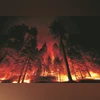
Over the past week, as eight wildfires destroyed vast portions of its home metropolis, Hollywood found itself violently impacted — and, at the same time, barely impacted at all.
With thousands of homes destroyed —many in neighbourhoods favoured by producers, executives, agents, and stars — and roughly 300,000 people under evacuation orders or warnings, little work got done at studio headquarters. Some studios closed entirely, others encouraged employees to work remotely.
Consider the impact of the fires on Disney alone. As of Monday, 64 Disney employees had lost their homes and hundreds more had been evacuated, including Robert A Iger, the chief executive, and three members of his leadership team. Iger has been overseeing Disney’s relief effort from a hotel, approving $15 million for community services and rebuilding efforts, arranging for Disney employees who have lost their homes to receive two months of free furnished housing and opening Disney’s studio wardrobe warehouses to employees who need clothes and shoes. He has also been calling employees who lost their homes. “I want them to know that people at the top of the company are looking after them, that we care,” Iger said by phone on Monday. “We’re going to go through some really tough times here, but we’ll get through it together.”
Meanwhile, Disney’s movie assembly lines — like the rest of Hollywood’s — have been almost completely unaffected.
Disney has seen some flurries of ash on its Burbank lot, but no flames. Pixar and Lucasfilm, both owned by Disney, are based in Northern California.
Also Read

 "malibu mansion, la fires")
 "The devastation of the Palisades Fire is seen at sunset in the Pacific Palisades neighborhood of Los Angeles")
 "wildfire")
 "wildfire")
 "Firefighters, California wildfire")
Sony Pictures is in Culver City, far from any of the fires. Paramount Pictures and Netflix are in Hollywood, the neighbourhood, which is 40 minutes by car from the two biggest fires. The sprawling Warner Bros and Universal Pictures lots in the San Fernando Valley have been untouched.
For the most part, live-action movies are no longer shot in the LA region. It’s too expensive. Instead, movie production has moved to states like Georgia, New York, New Jersey, and New Mexico and countries like Britain and Australia — all of which offer generous tax incentives.
Only two movies from major studios were affected by the fires. Filming was halted on “The Hand That Rocks the Cradle,” a 20th Century Studios remake of the 1992 thriller. The third “Avatar” movie, also from 20th Century, which Disney owns, briefly paused production.
Universal, Sony, Lionsgate, Legendary Entertainment, Netflix, Amazon’s Prime Video, Metro-Goldwyn-Mayer, Paramount, and Warner Bros had no movies shooting in LA over the past week.
“It has become a business where the edifices are based in Los Angeles, but much of the work happens in other places — and that in itself raises questions as people try to rebuild their lives,” said Terry Press, a veteran movie marketer and a past president of CBS Films. “If you are a craftsman in the industry, if you’re crew, why would you rebuild here?” she said. “Wouldn’t you go to where the work is? And what will that mean for the vibrancy of this community?”
IATSE, a union representing camera operators, makeup artists, prop makers, set dressers, lighting technicians, hairstylists, cinematographers, and other craftspeople, said on Monday that roughly 8,000 members live in parts of Los Angeles that been burned or evacuated.
Some film people, including a few studio executives who have lost everything, have been pushing for a quick return to business as usual. The Academy of Motion Picture Arts and Sciences on Monday extended the nominee voting period until the end of this week; the ceremony will take place on March 2 as planned. But others questioned a “show must go on” approach. “We have to ask ourselves: How do we as a business respond to real catastrophe?” Press said. “Thoughts and prayers and, by the way, my gown is by Gucci?” “The decision to be made is whether we protect the image or whether we set an example that mirrors the best storytelling by demonstrating empathy, leadership, compassion and heroism.” Hollywood has become experienced at soldiering forward. The fires follow the pandemic and two strikes, not to mention streaming-era upheaval.
©2025 The New York Times News Service
More From This Section
 "Joe Biden, Biden")
 "South Africa miners")
 "World Economic Forum, WEF")
 "Greenhouse gas emissions")
 "Tesla CEO and X owner Elon Musk")
Topics : Los Angeles fire Los Angeles Hollywood
Don't miss the most important news and views of the day. Get them on our Telegram channel
First Published: Jan 14 2025 | 11:04 PM IST