


Ukraine ceasefire talks in Paris lose momentum amid US' Venezuela focus
Before the US capture of Venezuelan leader Nicolas Maduro, French President Emmanuel Macron had expressed optimism about the latest gathering of so-called coalition of the willing nations
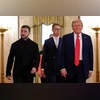 "U.S. President Donald Trump, Ukrainian President Volodymyr Zelenskiy and Finland's President Alexander Stubb walk during a meeting, amid negotiations to end the Russian war in Ukraine, at the White House in Washington, D.C., U.S., August 18, 2025 RE")
US President Donald Trump, Ukrainian President Volodymyr Zelenskiy and Finland's President Alexander Stubb walk. |File Photo: REUTERS.
Listen to This Article
Ukraine's allies are meeting Tuesday in Paris for key talks that could help determine the country's security after a potential ceasefire with Russia. But prospects for progress are uncertain, with the Trump administration's focus shifting to Venezuela while suggestions of a Greenland takeover are causing tension with Europe.
Before the US capture of Venezuelan leader Nicolas Maduro, French President Emmanuel Macron had expressed optimism about the latest gathering of so-called coalition of the willing nations. For months, they have been exploring how to deter any future Russian aggression should it agree to stop fighting Ukraine.
In a Dec. 31 address, Macron said that allies would make concrete commitments at the summit to protect Ukraine and ensure a just and lasting peace." Macron's office said Tuesday's meeting will gather an unprecedented number of officials attending in person, with 35 participants, including 27 heads of state and government. The US will be represented by President Donald Trump's envoys, Steve Witkoff and Jared Kushner.
Macron's office said the US delegation was initially set to be led by Secretary of State Marco Rubio, who changed his plans for reasons related to the military intervention in Venezuela.
Tension rises over Greenland comments
Witkoff and Kushner travel to the French capital after Trump on Sunday renewed his call for the US to take control of Greenland, a strategic, mineral-rich Arctic island.
Also Read

 "Greenland")
 "Cuban Ambassador to India Juan Carlos Marsan Aguilera")

 "Ramaswamy, Vivek Ramaswamy")
 "Venezuela")
Danish Prime Minister Mette Frederiksen and her Greenlandic counterpart, Jens Frederik Nielsen, rebuked Trump for his comments and warned of catastrophic consequences of any US effort to take over the island, saying it would amount to the end of the NATO military alliance.
Numerous European leaders sided with them, but the continent also needs US military might to back up any Ukrainian security guarantees and ward off Russia's territorial ambitions. That could require a delicate diplomatic balancing act in Paris.
Participants seek concrete outcomes on five key priorities once fighting ends: ways to monitor a ceasefire; support for Ukraine's armed forces; deployment of a multinational force on land, at sea and in the air; commitments in case there's another Russian aggression; and long-term defence cooperation with Ukraine.
But whether that's still achievable on Tuesday isn't so clear now, as Trump deals with the aftermath of his decision to effect leadership change in Venezuela.
Ukraine seeks firm guarantees from Washington of military and other support seen as crucial to securing similar commitments from other allies. Kyiv has been wary of any ceasefire that it fears could provide time for Russia to regroup and attack again.
Recent progress in talks
Before the US military operation targeting Maduro, Witkoff had indicated progress in talks about protecting and reassuring Ukraine.
In a Dec. 31 post, Witkoff tweeted that productive discussions with him, Rubio, and Kushner on the US side and, on the other hand, national security advisers of Britain, France, Germany and Ukraine had focused on strengthening security guarantees and developing effective deconfliction mechanisms to help end the war and ensure it does not restart.
France, which, with the United Kingdom, has coordinated the monthslong, multinational effort to shore up a ceasefire, has only given broad-brush details about the plan's scope. It says Ukraine's first line of defence against a Russian resumption of war would be the Ukrainian military and that the coalition intends to strengthen it with training, weaponry and other support.
Macron has also spoken of European forces potentially being deployed away from Ukraine's front lines to help deter future Russian aggression.
Important details unfinalized
Ukraine's President Volodymyr Zelenskyy said during the weekend that potential European troop deployments still face hurdles, important details remain unfinalized, and not everyone is ready to commit forces.
He noted that many countries would need approval from parliament even if leaders agreed to military support for Ukraine. But he recognised that support could come in forms other than troops, such as through weapons, technologies and intelligence.
Zelenskyy said that post-ceasefire deployments in Ukraine by Britain and France, Western Europe's only nuclear-armed nations, would be essential because some other coalition members cannot provide military assistance in the form of troops, but they do provide support through sanctions, financial assistance, humanitarian aid and so on.
Speaking frankly as president, even the very existence of the coalition depends on whether certain countries are ready to step up their presence," Zelenskyy said. "If they are not ready at all, then it is not really a coalition of the willing.
(Only the headline and picture of this report may have been reworked by the Business Standard staff; the rest of the content is auto-generated from a syndicated feed.)
More From This Section
 "switzerland fire, ski resort")
 "tariff, trade")
 "Bangladesh, Bangladesh Flag")
 "U.S. President Donald Trump, Ukrainian President Volodymyr Zelenskiy and Finland's President Alexander Stubb walk during a meeting, amid negotiations to end the Russian war in Ukraine, at the White House in Washington, D.C., U.S., August 18, 2025 RE")
Don't miss the most important news and views of the day. Get them on our Telegram channel
First Published: Jan 06 2026 | 7:13 PM IST