


Why the US now sees China's tech giants as a national security risk
The Pentagon's latest designation of Alibaba, BYD and Baidu reflects a broader US concern that technologies such as AI, batteries and cloud computing could strengthen China's military capabilities
 "us china, us-china, us flag, china flag")
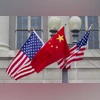
The US Department of Defence maintains a list of Chinese firms that it believes are linked to, controlled by, or supported by the Chinese military | Image: Bloomberg
Listen to This Article
The world over Alibaba is known as the world’s largest e-commerce platform. A company named BYD has taken the world with storm thanks to its cutting-edge electric cars. Baidu is sometimes referred to as China’s answer to Google.
None of them is known for manufacturing fighter jets, or missiles or warships.
But on Wednesday, Washington DC added all three to a list of companies linked to China’s military sector.
One could call it another move in the US-China rivalry, a move in which DC is no longer focused only on traditional defence contractors. Increasingly, it sees technologies such as artificial intelligence, cloud computing, batteries, robotics and autonomous systems as assets that can strengthen both commercial competitiveness and military power.
This shift may help explain why some of China’s most important civilian technology giants now find themselves in the crosshairs of the American national security apparatus.
Also Read

 "US China, Donald Trump, China US trade, China visit")
 "Pharma, chinese labs, research, experiment, science")
 "us pentagon")
 "US, Pentagon")
What’s the latest
According to Associated Press, the US Department of Defense has expanded its list of “Chinese military companies” operating in the United States. The latest additions reportedly include major Chinese firms such as Alibaba, BYD, Baidu, WuXi AppTec and Unitree, among others.
However, this classification does not automatically mean these companies are banned from doing all business in the US. They have not been put under full sanctions either. It restricts dealings with the US defence establishment.
What is the Pentagon’s China military list?
The US Department of Defence maintains a list of Chinese firms that it believes are linked to, controlled by, or supported by the Chinese military. It is associated with Section 1260H of US defence law.
Think of it as a US government warning list. The government uses it to flag companies that it thinks may have a role in strengthening China’s defence capabilities, regardless of the core nature of the companies.
The US uses this list to limit China’s access to sensitive technology, capital, and defence-linked commercial opportunities.
Why are civilian companies being named?
The key concept is dual-use technology.
Dual-use technology refers to products, systems or scientific capabilities that can serve both civilian and military purposes. A technology that makes a consumer product smarter and faster can also strengthen surveillance, logistics, battlefield communication, intelligence gathering or autonomous military systems.
AI is the clearest example. While its civilian applications are well known and widely accepted, its defence applications, such as military planning, satellite image analysis, cyber operations, surveillance and autonomous weapons systems, become a point of contention.
A similar argument applies to electric vehicle batteries. The technology that powers cars and buses also matters for drones, military vehicles, energy storage and mobile battlefield systems.
This overlap is why the US sees some Chinese technology companies not merely as commercial players, but as part of a wider strategic ecosystem.
Why the US is widening scrutiny of Chinese tech
The US campaign against Chinese technology firms began most visibly with telecom equipment, semiconductors and companies such as Huawei. The concern then was about network security, surveillance risks and control over critical digital infrastructure.
That scrutiny has now widened. Washington is looking at the entire technology stack that could shape future economic and military power: chips, cloud computing, AI models, batteries, EVs, robotics, drones, biotechnology, sensors and advanced manufacturing.
At the centre of this concern is China’s civil-military fusion strategy. The US believes Beijing can draw on civilian innovation, private companies and academic research to accelerate military modernisation.
China rejects many such US designations and says Washington is politicising trade and technology. Several companies named in such lists have also denied military links. That makes it important to treat the Pentagon’s designation as a US government claim, not as a final legal finding accepted by all sides.
Does this immediately hurt the companies?
The immediate impact may be limited. Alibaba, BYD, Baidu and others are global commercial players with large businesses outside the US defence ecosystem.
But the indirect consequences can still be serious.
First, investors may become more cautious. Funds with strict compliance rules may review exposure to named companies.
Second, US partners may re-evaluate business relationships to avoid future legal risks.
Third, the classification may lead to tougher measures, including investment restrictions, export controls or pressure for delisting.
For Chinese companies, the list may not be an immediate commercial ban, but it can act as a warning signal.
What to watch next
The key question now is whether this remains a warning measure or leads to tougher action. Another issue to watch is whether US investors begin reducing their exposure to the named companies.
The bigger picture is clear: the US-China technology rivalry is no longer only about chips or telecom equipment. It is increasingly about the civilian technologies that could shape future military power.
That is why an e-commerce platform, an EV maker and a search engine company can now find themselves at the centre of a defence and national security debate.
More From This Section
 "Artemis II, Artemis II moon rocket, Rocket, Rocket Launch, Launch Pad 39B")
 "Drought, Heat")
 "Bill Gates")
 "Afghanistan-Pakistan, Afghanistan Pakistan flag")
 "Iran, Iran flag")
Topics : US China China US trade US Pentagon
Don't miss the most important news and views of the day. Get them on our Telegram channel
First Published: Jun 10 2026 | 1:48 PM IST