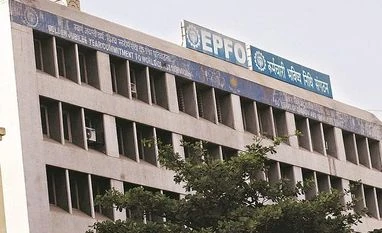
India’s Employees’ Provident Fund Organisation (EPFO) is changing its investment mix, prioritising state debt as it manages social security accounts of 258.8 million members.
EPFO’s share of state development loans (SDLs) — used to bridge the gap between a state government’s spending and income — has gone up by 16.03 percentage points since 2016-17. The share of such loans in the total debt corpus, based on face value, was 26.39 per cent in 2016-17. It has increased to 42.42 per cent, according to the latest available data, for 2020-21.
Investments in every other major category have dropped. EPFO’s share of central government securities is down 4.75 percentage points; the special deposit scheme share has fallen 2.58 per cent. The sharpest fall is in the money allocated to public sector financial institutions, public sector undertakings, and private sector bonds and securities. These have collectively seen a drop of 7.59 percentage points in the EPFO’s debt portfolio (see chart 1).
EPFO’s debt investments are worth Rs 14.46 trillion and equity investments, where exposure is relatively recent, are worth Rs 1.23 trillion.
The surge in state government paper comes as the gap widens between what subscribers get as returns for their money parked with EPFO and what the organisation can expect from debt markets — the yield on central government securities being one example. The gap between returns on 10-year central government securities and EPFO’s promised return to subscribers grew to its widest in almost a decade in 2020-21. State government securities typically offer higher interest rates. The difference between state and central government yields was at its highest in 11 years as of 2020-21 (see chart 2).
EPFO announced on March 12 that it would give its members 8.1 per cent interest on their holdings for 2021-22. This can be a challenging target because of relatively low interest rates on debt and volatility in equity markets. Higher allocations to state government debt pose their own challenges: poorer liquidity compared to central government bonds and a sense that yields may not fully reflect inherent risks.
The yield on a state government paper may not always fully reflect on a state’s ability to pay back the money.
It is not inconceivable that higher borrowings and increased market scrutiny could change risk perceptions for individual states. Indeed, there is a wide difference in the shortfall between what various state governments earn and what they spend, relative to the size of their economies (see chart 3).

 "BS Number Wise: An emerging trend in EPFO's debt investments")












 Connect with us on WhatsApp