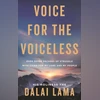
'Voice for the Voiceless' explores the Dalai Lama's Tibetan destiny

Tenzin Gyatso, the 14th Dalai Lama, has written a book that demands to be read cover to cover - especially by those who feel let down by his perceived softness towards the Chinese government

VOICE FOR THE VOICELESS
Chintan Girish Modi
5 min read Last Updated : Apr 14 2025 | 11:08 PM IST
VOICE FOR THE VOICELESS
Author: His Holiness the Dalai Lama
Publisher: Thorsons/HarperCollins
Pages: 256
Price: ₹699
  “The simple fact is no one likes their home being taken over by uninvited guests with guns,” writes Tenzin Gyatso, the 14th Dalai Lama, in his latest book Voice for the Voiceless: Over Seven Decades of Struggle with China for My Land and My People. It demands to be read from cover to cover, especially by people who feel let down by the Tibetan Buddhist monk for being too soft towards the Chinese government. His stance here is absolutely clear: Acting out of compassion does not mean staying silent in the face of injustice and oppression.
 
“The policies of Xi Jinping…seem to be focused on the tightening of control and intensification of measures aimed at assimilation,” he notes, drawing attention to reports about close to a million Tibetan children being admitted to Mandarin-only boarding schools against their parents’ wishes to create a generation of Tibetans whose first language will be Chinese. He also expresses his worries about the surveillance of monasteries and nunneries, and new rules that require these institutions to teach courses favouring Chinese authorities.
 
The bitter truth is that the Dalai Lama has spent more time outside rather than inside Tibet. Having escaped to India in 1959, nine years after China’s invasion of Tibet, the author will turn 90 in July this year. He was only 25 years old when he became a leader in exile. A lot has changed in these six and a half decades, but Tibetans continue to yearn for their freedom. Given the Dalai Lama’s age, there is much speculation about the political future of Tibetans in their own homeland in the event that a resolution is not found in the man’s own lifetime. He addresses these concerns in a pragmatic manner, garnished with his characteristic humour.
 
Since the current Chinese leadership has been quite candid about its intention to select his successor, he points out that “it is totally inappropriate for Chinese Communists, who explicitly reject religion, including the idea of past and future lives, to meddle in the system of reincarnation of lamas, let alone that of the Dalai Lama”. The argument is compelling because, according to Tibetan Buddhist tradition, the Dalai Lama is believed to be an emanation of Chenrezig or Avalokiteshvara, the Bodhisattva of Compassion, and the search for a future Dalai Lama involves elaborate religious procedures, including consultation with a wrathful deity named Palden Lhamo and an oracle called Dorje Drakden or Nechung. It is safe to assume that these matters lie outside the competence of the Chinese Communist Party.
 
Not one to miss an opportunity to crack a joke, the author adds, “…it should first recognise the reincarnations of its past leaders Mao Zedong and Deng Xiaoping!” It is evident that the suggestion is made without malice. Despite his failed attempts to engage successive generations of Chinese leaders in meaningful dialogue, he has not given up on the idea that one must “see the humanity even in our oppressors, because, ultimately, it will be with their humanity that we come to some kind of settlement”. This might sound naïve to many readers but it is entirely consistent with the Mahayana Buddhist worldview. It is believed that all sentient beings have the inherent potential to attain Buddhahood or enlightenment.
 
Moreover, Buddhist literature contains several examples of individuals who adopted nonviolence when they were able to see the harm that their actions had caused. Angulimala, the serial killer who gave up killing and embraced monastic life after meeting Gautama Buddha—and the Mauryan emperor Ashoka who renounced violence after witnessing the bloodshed and destruction during the Kalinga War—are perhaps the most widely known.
 
It is admirable that the author does not pretend that his optimism is shared by all Tibetans. He writes, for instance, that his “Middle Way Approach”—which seeks autonomy rather than independence for Tibet—has been a disappointment for some Tibetans, and was even criticised by his own brother, Taktser Rinpoche, who called the proposal “a sell-out”. The Dalai Lama and the Central Tibetan Administration in Dharamsala are of the opinion that the Chinese leadership will feel less threatened and be more amenable to protecting the Tibetan people’s culture, religion, language and human rights if they dilute their demands. However, as the author notes, the Tibetan Youth Congress aims for nothing less than “total independence”.
 
His unshakeable faith is moving to witness. He writes, “Today’s dark period of Communist Chinese occupation may seem endless, but in our long history, it is but a brief nightmare. As our Buddhist faith teaches us, nothing is immune to the law of impermanence.” Equally inspiring is his belief in the possibility of friendship between the Tibetans and the Chinese. He recounts numerous interactions with Chinese intellectuals, artists, writers and business leaders. One of them—a young student—revealed that his grandfather served in the People’s Liberation Army that attacked Tibet in 1950 and wanted to apologise to the Dalai Lama.
 
This book is undoubtedly a must-read, but it is surprising that it gives the impression that all Tibetans practise Buddhism. The author does not refer to Tibetans who practise Islam, Christianity, and the Bon religion, and those who are atheists. Speaking of this diversity among Tibetans is crucial since the Dalai Lama is committed to interreligious dialogue.
The reviewer is a journalist, educator and literary critic. He can be reached @chintanwriting on Instagram and X

One subscription. Two world-class reads.

Already subscribed? Log in

Subscribe to read the full story →
*Subscribe to Business Standard digital and get complimentary access to The New York Times

Smart Quarterly

₹900

3 Months

₹300/Month

SAVE 25%

Smart Essential

₹2,700

1 Year

₹225/Month

SAVE 46%
*Complimentary New York Times access for the 2nd year will be given after 12 months

Super Saver

₹3,900

2 Years

₹162/Month

Subscribe

Renews automatically, cancel anytime

Here’s what’s included in our digital subscription plans

Exclusive premium stories online

  • Over 30 premium stories daily, handpicked by our editors

Complimentary Access to The New York Times

  • News, Games, Cooking, Audio, Wirecutter & The Athletic

Business Standard Epaper

  • Digital replica of our daily newspaper — with options to read, save, and share

Curated Newsletters

  • Insights on markets, finance, politics, tech, and more delivered to your inbox

Market Analysis & Investment Insights

  • In-depth market analysis & insights with access to The Smart Investor

Archives

  • Repository of articles and publications dating back to 1997

Ad-free Reading

  • Uninterrupted reading experience with no advertisements

Seamless Access Across All Devices

  • Access Business Standard across devices — mobile, tablet, or PC, via web or app

Topics :Dalai LamaFree TibetTibetBook readingBOOK REVIEWBS Reads

Next Story