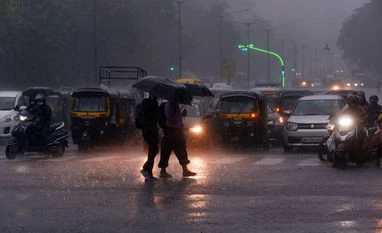
The India Meteorological Department (IMD) soothed nerves, especially about food supplies, when it forecast a "normal" monsoon for the June-September period at 96 per cent of the long period average (LPA).
IMD’s first monsoon forecast for the year followed private weather forecasting agency Skymet’s prediction of a below-par monsoon at 94 per cent of the LPA. Both forecasts have a model error of plus and minus five per cent.
In meteorological terms, there is a world of difference between "normal" and "below normal" forecasts. Both IMD and Skymet had almost similar views on the emergence of El Nino, a weather pattern that occurs in the Pacific Ocean, during the four-month monsoon season. What they differed on was the impact of El Nino and other factors in shaping the monsoon’s trajectory this year.
Skymet said a strong Indian Ocean Dipole (IOD), another factor influencing Indian monsoon, could negate El Nino’s effect. The IOD is neutral now and is leaning to turn moderately positive at the start of the monsoon.
"El Niño and IOD are likely to be 'out of phase' and may lead to extreme variability in the monthly rainfall distribution. The second half of the season is expected to be more aberrated," said Skymet on April 10. IMD said two days later that neutral IOD conditions are present over the Indian Ocean and the latest climate models forecast indicates that the positive IOD conditions are likely to develop during the southwest monsoon season.
"Positive IOD is good for southwest monsoon over India," IMD said.
What makes a monsoon
It added that the snow over the Northern Hemisphere and Eurasia was below normal between December 2022 and March 2023. Thin snow cover in two places in winter and spring is favorable for the subsequent southwest monsoon rainfall over India.
Skymet said El Nino’s impact will overshadow all positives, but IMD said "ancillary factors" will balance out the negative impact.
More than the actual quantum of monsoon rains, their timeliness, distribution and spread are of vital importance for crops' life and growth.
Rains were ‘above normal’ at over 106 per cent of the LPA in 2022, but large tracts of India, particularly Bihar, Jharkhand and eastern Uttar Pradesh, suffered drought-like conditions.
Weather forecasters say that in any given year around 25-30 per cent of the Indian landmass gets rains that are less than is normal for monsoon months.
A normal monsoon is important for agriculture and allied activities and therefore for food and overall retail price inflation.
Many economic forecasters, including the Reserve Bank of India, make an assumption of normal monsoon while projecting inflation.
However, there are other factors such as international supplies, Covid-19 lockdowns and Russia-Ukraine may keep inflation rate elevated.
The years 2020-21 and 2022-23 are apt examples of factors other than monsoon keeping food and overall retail price inflation high.
Similarly, all El Nino in the past 15 such events since 1951 haven’t always led to below normal rains and in 40 per cent times rains in El Nino years have been normal.
But, the counter argument to this is that 60 percent of El Nino years have led to below normal rains and therefore, the probability of El Nino impacting the monsoon rains is more than it not impacting the same.
This year, most experts and policy makers feel that given that inflation trajectory mainly in food items is on a downward slide, prices might not immediately move upwards particularly of key items like wheat, rice, edible oils and even some pulses if they are managed efficiently.
But, the big black hole in this is vegetables and fruit prices.
Vegetables are most impacted by dry and hot weather and uneven rains. Managing their supplies is tricky in the absence of any big ticket central intervention.
Consumer price index (CPI) inflation has decreased in the last one year due to abundant supplies, but whether any break in rains will keep it down remains to be seen in the next six to eight months.