As environment-friendly electric vehicles (EVs) become popular in India, a century-old electric transport system that too ticks the “green” box is fading in Kolkata: the tram car. The city had 14 tram routes in 2017-18, reduced to five in 2020, and three remain now.
Debasish Bhattacharyya, president of Calcutta Tram User Association (CTUA), which is fighting to secure the transport system, said there were about 36 routes originally.
“Roads account for only 6 per cent of the land in the city. Given the population density of Kolkata and vehicles on the road, it’s impossible to run trams everywhere,” West Bengal transport minister Snehasis Chakraborty told Business Standard.
The city’s traffic management was ‘very good’ and trams could ‘contradict’ that. Once work on the Kolkata metro was completed in 2025, one or two tram routes may be restarted, he said.
The tram service has shrunk due to work on the metro, reconstruction or maintenance of bridges, traffic, and state policies. Trams worked best 100 years back but faster modes of transportation are required now, said Rajanvir Singh Kapur, managing director of West Bengal Transport Corporation (WBTC). “The city is much bigger now; there is immense stress in the central business district and increasing competition for road space.”
For WBTC, which runs bus and ferry services too, trams come last in terms of income. The transport minister assured that trams would be retained for their heritage status and people’s emotions.
Kolkata trams—now in their 150th year—are the last to survive modernity in Indian cities. Mumbai gave up the service in 1964; Delhi and Chennai shuttered theirs earlier. It’s an important transport system still in some European cities. There are also famous examples of shutdowns and comebacks.
Strasbourg in France had a 60-km tram network more than a century back but the service became almost non-existent three decades ago, said Anish Mandal, Partner, Deloitte India.
Strasbourg reconstructed the network and some other cities in France followed. In Australia, Melbourne retained trams and Sydney discontinued them. Sydney’s last tram network closed in 1961, said Rowan Ainsworth, Australian Consul-General in Kolkata.
Barry O’Farrell AO, Australia’s High Commissioner to India, when he was premier of New South Wales province in 2012 committed to re-introducing tramlines to reduce congestion in Sydney’s central business district, said Ainsworth.
“And, of course, trams also improve environmental outcomes,” she said.
Sydney’s tram project approximately cost AUD 2.9 billion and it was a success on completion. More than 25 million passenger journeys were made in 2022, she said.
Do trams have a future amid a push for green mobility? Electric trams have zero-tail pipe emission and can draw electricity from the grid directly, said Mandal of Deloitte India.
Last month, the Calcutta High Court said that further bituminizing or removing tram tracks shall not be done till a decision was taken by the court on the writ petition filed by NGO, People United for Better Living in Calcutta (PUBLIC).
“We have asked the court to appoint a committee of experts to assess the transportation needs of the city and the role of trams in fulfilling it,” said Pradeep Kakkar, founding member of PUBLIC.
“The decision of the government to put in an increased number of electric buses in the transport system claiming that it is eco-friendly is contrary to their stand in dismantling the tram network. Trams are eco-friendly and should be considered not just for retention but modernization and expansion. They are certainly far more efficient in moving people than four-wheelers,” he said.
According to Mandal, the focus should be on manufacturing new air-conditioned tram coaches and expanding their network. “This would transform trams into a valuable asset for the state, promoting tourism and facilitating clean public transportation.”
But there are challenges. Considering the massive financial commitment which it takes to revive and expand the tram network and the urban transport planning-related challenges, Mandal said, the best course of action for Kolkata would be to preserve the tram system network, shift to modern technologies, and over time expand as the planning permits.
The decline of trams has been steady since the 1990s, said CTUA’s Bhattacharyya. He recalled that Shyamal Chakraborty, transport minister in the Left Front government had said, trams are obsolete – they will die a natural death.
“Before private buses were allowed, around the 1970s, trams used to carry 40 per cent commuters and CSTC buses 60 per cent. Now, in percentage terms, trams’ share would be negligible,” Bhattacharyya said.
A tram restaurant, a tram library, a clutch of AC trams with Wi-Fi have been introduced to keep the vintage transport system in keeping with the times.

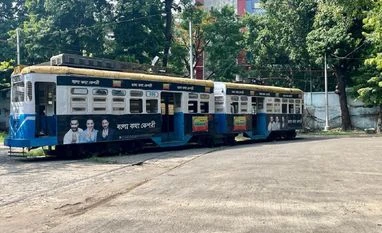 "Amid India's EV buzz, Kolkata's electric trams struggle to keep rolling")











