Prime Minister Narendra Modi’s renewed push for electric mobility has strengthened confidence across India’s EV industry at a time when sales momentum is already accelerating sharply, with automakers, charging firms and policy experts betting on faster adoption even as some executives warn of mixed policy signals from the government itself.
India’s electric vehicle (EV) market maintained strong momentum in April 2026, with electric passenger vehicle (PV) sales rising 75.1 per cent year-on-year (Y-o-Y) to 23,506 units, while electric two-wheeler (E2W) sales grew 60.7 per cent to around 149,000 units, according to Federation Of Automobile Dealers Associations (Fada) data. During 2025-26 (FY26), E2W sales crossed 1.4 million units, up 21.8 per cent Y-o-Y, while electric PV sales surged 83.6 per cent to nearly 200,000 units.
Anirudh Ravi Narayanan, chief executive officer (CEO) and cofounder of Bharat New-Energy Company, an E2W maker, said the company has seen a sharp increase in EV orders from B2B customers such as quick commerce and food delivery firms in recent months. Adoption accelerated nearly three-fold in the last month alone and expanded beyond select markets to become more widespread across the country, he added.
A spokesperson for Tata Motors said the Prime Minister’s remarks reinforce the role of EVs in improving India’s energy security by reducing dependence on oil imports. It said the biggest opportunity remains the mass-market PV segment priced below ₹12 lakh, which accounts for nearly 65 per cent of the domestic PV market but still has low EV penetration. Tata Motors added that improving affordability and reducing adoption barriers remain central to its EV strategy.
Anurag Singh, managing director at Primus Partners, said the industry is well positioned for strong growth in FY27 after robust momentum in FY26 across vehicle categories. He said total cost of ownership has already turned favourable in segments such as E2W, electric three-wheelers, e-buses and fleet vehicles, while financing, charging infrastructure and supply chains continue to improve steadily.
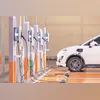
Rising fuel price uncertainties are making EVs more of an economic consideration.
Akshay Shekhar, cofounder and CEO of Kazam, said rising fuel uncertainty has made EVs a mainstream economic consideration rather than only a sustainability choice. He said higher EV demand would help automakers achieve economies of scale and eventually lower costs, but added that charging infrastructure remains critical for long-term adoption. “India’s EV transition will scale only when charging becomes safe, accessible, interoperable and deeply integrated with the grid,” he said.
However, a senior executive at a major EV maker said policy messaging remains inconsistent despite the Prime Minister’s strong endorsement of electric mobility.
“Take the ongoing discussions between the auto industry and the Bureau of Energy Efficiency on the draft CAFE-3 norms. The draft does not unequivocally push EVs but also gives incentives to vehicles with significant tailpipe emissions, such as strong hybrids,” the executive said.
He added that the February 2026 NITI Aayog report advocating a broader transition strategy involving hybrids and alternative fuels had also created uncertainty within the industry before being partially revised following objections from EV-focused automakers.

 "PM Modi's EV push lifts industry confidence, but policy gaps persist")












 Connect with us on WhatsApp