India to be 3rd-largest economy by 2028; equities remain pricey: UBS
From a stock market perspective, however, UBS remains underweight on Indian equities as valuations in their view still look expensive relative to the ordinary fundamental performance of companies.
Puneet Wadhwa New Delhi India could maintain potential real GDP (gross domestic product) growth of 6.5 per cent year-on-year (YoY) between FY28-30, making it the world's third-largest consumer market in 2026 and third-largest economy by 2028 after the US and China, said analysts at UBS in a recent report.
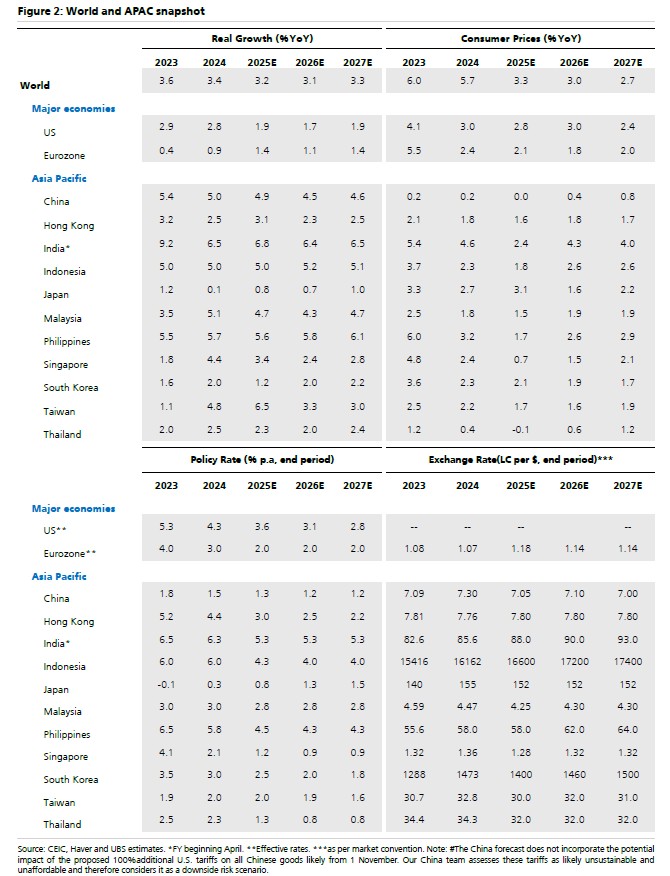
Global growth, it believes, could slow marginally to 3.1 per cent 2026 from 3.2 per cent in 2025, before rising to 3.3 per cent in 2028.
From a stock market perspective, however, UBS remains underweight on Indian equities as valuations in their view still look expensive relative to the ordinary fundamental performance of companies.
While retail flow still supports the market, UBS said, selling pressure from foreign investors and (increasingly) IPO/capital-raising activity by corporates must be watched.
CLICK HERE FOR UBS' WORLD, APAC FORECAST "India lacks any direct artificial intelligence (AI) beneficiary stocks, unlike other larger markets. Among sectors, we prefer banks and consumer staples in the Indian context," their analysts wrote.
The stance is in stark contrast to peers such as Goldman Sachs that have upgraded Indian equites to 'overweight' with a Nifty target of 29,000; and Morgan Stanley that expects the Sensex to hit the 100,000 mark by June 2026.
READ ABOUT IT HERE MSCI India, meanwhile, is up by 3.9 per cent year-to-date (YTD), underperforming EM by 33.6 per cent, and on an index-weighted basis is trading at a 48 per cent premium (12-month forward PE) to EM.
In their base case, UBS has assumed that US-India trade deal will materialise, and the additional 25 per cent penalty will be withdrawn, reciprocal tariff on India is lowered to around 15 per cent (closer to the levels of other Asian countries) by December 2025-end.
India's growth rates
India’s real GDP growth, UBS said, is likely to stabilise at 6.4 per cent YoY in FY27 (10bps below consensus) and 6.5 per cent in FY28, on supportive policy and strong domestic demand, making it the fastest growing economy in the Asia Pacific (APAC) region in 2027, followed by Philippines (GDP growth at 6.1 per cent) and Indonesia at 5.1 per cent.
“India's household consumption nearly doubled in the past decade to $2.4 trillion in 2024, recording a 7.9 per cent CAGR, stronger than China, the US and Germany. Our estimates indicate India's consumer market is on track to become the world's third largest in 2026, well before its GDP does by 2028,” wrote Tanvee Gupta Jain, economist at UBS in a coauthored report with Nihal Kumar.
For the US, GDP growth, UBS said, is expected to slow from 1.9 per cent in 2025 to 1.7 per cent in 2026 and recover to 1.9 per cent in 2027. Real GDP growth in China, the report said, is likely to slow to 4.5 per cent in 2026 (from 4.9 per cent in 2025), mainly on a smaller growth contribution from net exports.
Two-sided risks
UBS' growth forecast for India is, however, subject to two-sided risks, particularly regarding uncertainty related to US trade policy and India's policy response.
Firstly, in case the 50 per cent trade tariff persists (including the penalty), it could drag growth by around 50 basis points (bps) in FY27 and there would be a knock-on impact on employment, consumption and business confidence, with a further drag on investment.
Secondly, a 25 per cent tax on payments made by US companies to foreign outsourcing services, could lower India's growth by a significant around 90bps in FY27, UBS believes.
Consumer price inflation (CPI), meanwhile, is likely to rise, UBS said, from 2.4 per cent YoY in FY26 to 4.3 per cent YoY in FY27 (largely on a base effect), albeit below the Reserve Bank of India’s (RBI’s) 4.5 per cent forecast. UBS expects the RBI to cut rates by another 25bp in the remaining months of FY26 before taking a long pause in FY27.

 "India to be 3rd-largest economy by 2028; equities remain pricey: UBS")