Home / Markets / News / Reciprocal tariffs: India, Thailand most impacted in Asia, says Nomura
Reciprocal tariffs: India, Thailand most impacted in Asia, says Nomura
On Wednesday, US president Donald Trump reiterated his stance to impose reciprocal tariffs on counties, including India from April 02, 2025, during his address to the Congress
US President Donald Trump announced that the country would implement reciprocal tariffs on multiple nations beginning April 2
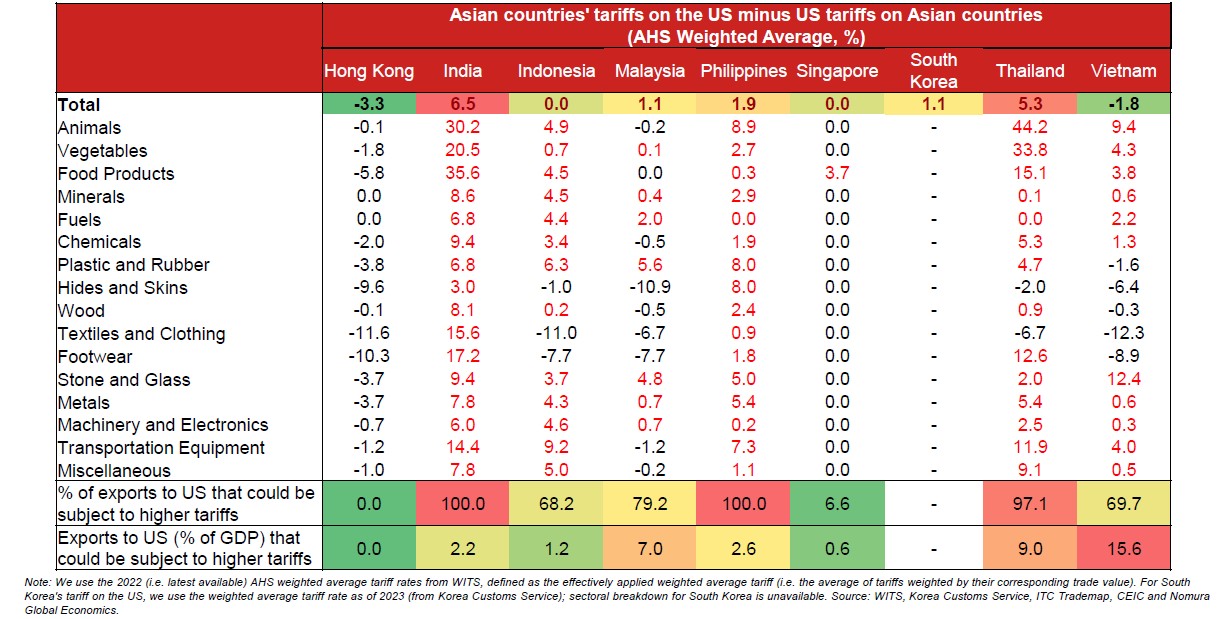
India and Thailand are at risk of higher reciprocal tariffs by the United States (US), suggests a recent note by Nomura. Reciprocal tariffs, it expects, will be imposed based on tariff gap, value added tax (VAT) and non-tariff barriers, among other factors.
“Emerging Asian economies (especially India and Thailand) have higher relative tariff rates (on US exports) and are thus at risk of higher reciprocal tariffs. By sector, Asia imposes higher tariffs on agricultural products and transportation. The former is generally politically difficult for Asia to lower, but countries could lower their tariff rates on the transport sector, which includes motor vehicles,” wrote Sonal Varma, chief economist for Asia ex-Japan and India at Nomura in a coauthored note with Si Ying Toh, Nomura's economist for Asia ex-Japan and Taiwan.
Among sectors / product categories, animals, vegetables, food products, textiles and clothing, footwear and transportation equipment are likely to be hit the hardest, Varma and Toh wrote. CLICK HERE FOR A DETAILED BREAKUP
On Wednesday, US president Donald Trump reiterated his stance to impose reciprocal tariffs on countries, including India from April 02, 2025, during his address to the Congress.
“If you don’t make your product in America under the Trump administration, you will pay a tariff, and in some cases, a rather large one. Other countries have used tariffs against us for decades and now it's our turn to start using them against those other countries,” Trump said. ALSO READ: Why Indian stock markets rallied despite Trump's reciprocal tariff threat?
Non-tariff barriers
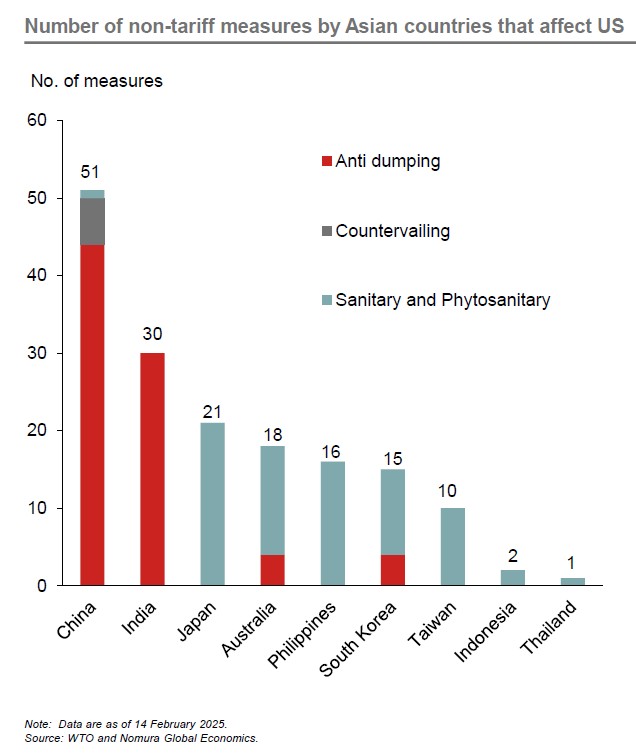
Meanwhile unlike tariffs, non-tariff barriers, Nomura said, are harder to quantify as they include import policies, sanitary and phytosanitary measures, technical barriers to trade, export subsidies, a lack of intellectual property protection etc.
A 2024 USTR report lists China, India, Indonesia, the Philippines, Taiwan and Thailand as having higher non-tariff barriers.
Broadening the criteria to include non-tariff barriers, Nomura said, increases the likelihood of the imposition of a reciprocal tax across a broader swath of emerging and developed Asian economies.
In case the Trump administration looks to impose tariffs on imports from third countries that are being used to circumvent tariffs, Nomura expects specific products from Vietnam, Malaysia and Thailand, which have a higher share of China value added in their goods exports to the US, to be also vulnerable.
To objectively quantify non-tariff barriers, Nomura used the WTO’s Integrated Trade Intelligence Portal, which showed China and India as having the highest non-tariff barriers in Asia, with both countries using antidumping measures as a retaliatory tool.
“Developed Asian economies have also imposed non-tariff barriers via sanitary and phytosanitary measures. These include Japan, South Korea and Taiwan, which also run a trade surplus with the US. Singapore, which runs a trade deficit with the US and has low trade and non-trade barriers, appears least at risk from a reciprocal tax,” Nomura said.
Universal tariffs
A clean way to estimate Asia’s direct exposure to the US is by looking at the share of Asia’s exports to the US. Vietnam with an exposure of 25.1 per cent of its gross domestic product (GDP) in 2024 to the US will be the worst hit Asian region, followed by Taiwan at 14 per cent, Thailand (10.4 per cent), Malaysia (10.3 per cent) and Hong Kong (9.5 per cent). CLICK FOR GRAPHIC
Indian exports to the US that account for 2.2 per cent of its GDP could be at risk in case universal tariffs are implemented, according to Nomura's estimates.

 "Reciprocal tariffs: India, Thailand most impacted in Asia, says Nomura")