Associate Sponsors

Co-sponsor

A SCOTUS indebted to Trump strikes a blow against his powers, nonetheless

The US Supreme Court curbs Donald Trump's tariff powers, reaffirming congressional authority and showing how institutional checks can still restrain populist executives
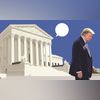
US Supreme Court, Donald Trump
A court indebted to the President nevertheless strikes a blow against his powers | Illustration: Ajaya Kumar Mohanty
Mihir S Sharma
6 min read Last Updated : Feb 22 2026 | 10:12 PM IST
The United States (US) Supreme Court has struck down President Donald Trump’s indiscriminate use of tariffs as a tool of trade policy, throwing his second-term agenda into a degree of confusion. This was both a surprising and an unsurprising turn of events, in different ways. For those who were paying attention, it had become clear that the judges on the court, even some of those who are on the conservative side of the spectrum, appeared unconvinced by the arguments being presented by the administration’s lawyers. 
On the other hand, for Mr Trump to be handed a 6-3 setback by a court that has otherwise appeared in sympathy with his aims and methods is somewhat startling. The Supreme Court has so far refused to step in on multiple occasions when it might have. It has disallowed lower courts from acting to stop the President gutting the US’ civil service, for example, and allowing him to proceed with his extremely disruptive acts on immigration enforcement. For this case, however, the first of Mr Trump’s second-term acts to which it gave its full attention, it has ruled against him. Two of his own appointees to the court voted against his administration. 
This is a fascinating reminder of how checks and balances might still work in some situations to counter the power of a populist. By and large, courts across the world, including in the US, have been very hesitant to pass rulings that clearly go against the leader of the executive putting into place policies for which he has appeared to receive a democratic mandate. That is certainly the case with Mr Trump’s tariffs — those are, after all, his signature policy, and he has been unusually consistent throughout his political career and even earlier about their utility. But, on this occasion, the court has insisted that he receive congressional authorisation because he has gone beyond the authority that the legislature has delegated to the executive. 
It is important to note that, from the court’s point of view, this was a very limited judgment. The administration had argued not only that the President had been given the power to impose tariffs, but also that they were useful and justified. The court not only did not pronounce on the latter argument, it specifically made the point that it was not qualified to, and that only the 
US Congress was. Other supreme courts that have waded into economic matters would benefit from a touch of this humility. 
The effect of this ruling on Mr Trump will no doubt play out over some time. The length of the oral arguments in this case — it has been proceeding for several months — will have given him some time to adjust to the likelihood that the tariffs will be struck down. So, although he has publicly attacked the judges, he has also been able to curb his usual impetuousness somewhat. However, he may get more and not less angered over this as time passes. The fact is that he had begun to use tariffs as his primary tool of foreign-policy intimidation, and having this instrument removed from his arsenal will constantly frustrate and infuriate him. 
So far, the administration has responded by claiming that as far as possible it will replicate its menu of tariffs using other laws that delegate some trade policy authority to the White House. A baseline tariff of 10 per cent under a law that allows for emergency actions up till 15 per cent for 150 days has already been imposed — partly to ensure that the government doesn’t have to start repaying companies from whom it had already taken tariff money. 
What the White House does not plan to do is almost as interesting. Few expect it to return to Congress, where Republicans technically control both chambers, to demand that it give explicit authorisation to the President on trade policy. This suggests that it is not quite as sure as it would like of the level of support that this policy would receive — particularly in the Lower House, in which the party’s slim majority is quite clearly threatened in the midterm elections later this year. 
Occasionally, the institutional strength of modern democracies can reassert itself. Over the past few days, we have seen several examples of this. The most powerful man in the world has had his signature policy removed from his arsenal. Across the Atlantic, a member of the British royal family was summarily arrested on his birthday, probably for leaking official secrets. In South Korea, a former President who attempted a coup has been sentenced to life imprisonment. 
It is important, therefore, to remember that even present-day populists, who specialise in a stealth takeover of the state, may not always be able to turn the entire establishment to their will. It only takes one or two institutions that are ready to resist to create serious trouble. 
The most effective ones will, however, adapt. President Trump can console himself that his “Liberation Day” tariffs have already made the point he wanted them to make. Many of the US’ trading partners, including India, were pushed by them into signing specific trade deals that opened access to a spectrum of US goods. And, even now, if he were to threaten tariffs against some defenceless economy, there would be an edge of credibility to that threat. It is hard to believe, for example, that the European Union is suddenly going to start taking the threat of US tariffs less seriously; people are more likely to believe that Mr Trump will find some roundabout way of reimposing them if he really wants to. 
It is, however, a reminder that America remains a large and complex country, and should not be reduced to one man’s issues and enthusiasms. There is no doubt that Mr Trump has moved the needle in US politics significantly. He has had a hectic first year in office. But, over the next few months, and as the midterms approach, the limits of his power — and the pushback against his actions — may become more apparent.

One subscription. Two world-class reads.

Already subscribed? Log in

Subscribe to read the full story →
*Subscribe to Business Standard digital and get complimentary access to The New York Times

Smart Quarterly

₹900

3 Months

₹300/Month

SAVE 25%

Smart Essential

₹2,700

1 Year

₹225/Month

SAVE 46%
*Complimentary New York Times access for the 2nd year will be given after 12 months

Super Saver

₹3,900

2 Years

₹162/Month

Subscribe

Renews automatically, cancel anytime

Here’s what’s included in our digital subscription plans

Exclusive premium stories online

  • Over 30 premium stories daily, handpicked by our editors

Complimentary Access to The New York Times

  • News, Games, Cooking, Audio, Wirecutter & The Athletic

Business Standard Epaper

  • Digital replica of our daily newspaper — with options to read, save, and share

Curated Newsletters

  • Insights on markets, finance, politics, tech, and more delivered to your inbox

Market Analysis & Investment Insights

  • In-depth market analysis & insights with access to The Smart Investor

Archives

  • Repository of articles and publications dating back to 1997

Ad-free Reading

  • Uninterrupted reading experience with no advertisements

Seamless Access Across All Devices

  • Access Business Standard across devices — mobile, tablet, or PC, via web or app

Topics :Donald TrumpUS Supreme CourtTrump tariffsTrump trade policyBS OpinionTrump administration

Next Story



