By Matt Day Microsoft Corp. announced its first quantum computing chip, a major step in the company’s effort to produce devices that might someday solve problems beyond the reach of modern computers.
The company says its Majorana 1 chip harnesses 8 qubits, the building blocks of quantum computing, on a sticky-note-sized piece of hardware it figures could eventually host 1 million of them. Right now, the chip is capable of little more than solving math problems that prove it can be controlled. But Microsoft engineers say it’s far enough along to serve as the foundation for future quantum machines.
ALSO READ: Microsoft unveils generative AI tool that can create video-game scenes Microsoft’s announcement indicates that its engineers have found a way to deploy the particles that make quantum computing possible in a system that might one day power data centers and enable advances in fields like chemistry and health care. Some of the findings, outlining the operation of what the company calls a topoconductor, are being published Wednesday in the journal Nature.
“Scientists actually theorized this in 1937,” said Jason Zander, a Microsoft executive vice president charged with bringing quantum and other promising technologies to market. “It’s taken us nearly a hundred years to prove it. Now we can harness it.” He added that quantum machines will be doing useful things in “years, not decades.”
The field of quantum computing, whose imminent arrival has been predicted for about a decade, has seen a flurry of announcements in recent months indicating that the machines may be nearing practical utility.
The technology marks a departure from the foundational structure of computers. Whether it’s an iPhone or a supercomputer in a data center, all computers process information in units called bits, which are encoded as either a one or a zero. Quantum bits – or qubits – represent probabilities of a one or a zero, at times appearing as both.
Owing to that pliability, strings of qubits can consider several possibilities at once, enabling them to find solutions to problems that befuddle traditional machines firmly tethered to ones and zeroes. Alphabet Inc.’s Google in December announced that its own new quantum chip took five minutes to reason through a problem that would take traditional computers longer to solve than the universe’s age.
The trouble – for Google, Microsoft and a host of startups plugging away at quantum machines — is the technology’s error rate. Producing the particles that can be electronically controlled requires supercooled, quiet environments because stray heat or sound waves can introduce mistakes. In experiments, these particles blink in and out of existence in a fraction of a second. And correcting their errors can be as big a challenge as creating the particles.
Microsoft, which started its quantum work in 2004, took a different approach than most by focusing its efforts on minimizing errors — specifically on Majorana, quasiparticles named for the Italian physicist who theorized them in the 1930s. Microsoft believes Majorana qubits will prove less prone to inadvertent flips between ones and zeros than qubits created by other approaches.
To isolate and control Majorana, Microsoft cobbled together, atom-by-atom, strips of indium-arsenide, and joined aluminum nanowires together in an H shape. When cooled to near absolute zero and precisely tuned with a magnetic field, Majorana are induced at each of the letter’s four ends, making a single qubit. It gives off signals — the ones and zeroes — that engineers can read with microwaves. That structure can be repeated across a chip.
There were some false starts: Microsoft researchers thought they’d identified the particles in 2018, but later retracted the paper that sought to prove it. Eventually they cracked the problem and managed to create and measure Majorana a few years later.

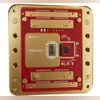 "Microsoft unveils first quantum computing chip for future data centres")


 Connect with us on WhatsApp