US Vice President JD Vance addressed a global summit on
artificial intelligence in Paris, reaffirming the Trump administration's commitment to keeping AI development in the United States “free from ideological bias” and ensuring that American citizens’ right to free speech remains protected.
During his speech on Tuesday, Vance warned that “excessive regulation” of AI could stifle innovation in this transformative industry. Speaking before an audience of world leaders, top tech executives, and AI researchers, he stressed that overregulation would deter risk-taking and slow down progress.
“Now, at this moment, we face the extraordinary prospect of a new industrial revolution, one on par with the invention of the steam engine,” Vance stated.
“But it will never come to pass if overregulation deters innovators from taking the risks necessary to advance the ball," he added.
Global AI power struggle
The Paris summit has become a key battleground for international AI governance, exposing sharp divides in global AI strategy. The event highlighted three competing approaches to AI dominance:
- The US, under President Donald Trump, promotes a hands-off, pro-innovation policy.
- Europe is pushing for stricter AI regulations while boosting public investment in the sector.
- China is rapidly expanding its AI capabilities through state-backed tech giants, seeking global leadership in AI standard-setting.
Chinese Vice Premier Zhang Guoqing’s participation in the summit demonstrates Beijing’s ambitions to shape global AI policy. Meanwhile, Vance’s remarks highlighted Washington’s resistance to stringent AI oversight, further illustrating the divide between the US and its European allies.
Vance has been a vocal critic of European digital policies, particularly content moderation on major platforms. He has suggested that the US should reconsider its Nato commitments if European nations impose restrictions on Elon Musk’s social media platform, X. His Paris visit is also expected to include candid discussions on Ukraine, AI’s influence on global power shifts, and escalating US-China tensions.
Debating AI regulation
Concerns over AI’s rapid evolution—and its potential risks—loomed over the summit, particularly as nations wrestle with how to regulate a technology increasingly entwined with defense, cybersecurity, and economic competition.
“I think one day we will have to find ways to control AI, or else we will lose control of everything,” cautioned Admiral Pierre Vandier, Nato’s top modernisation strategist.
Amid diplomatic tensions, leaders also launched “Current AI”, a global public-private initiative designed to support large-scale AI projects for the public good. Analysts see this as an effort to counterbalance corporate dominance in AI development. However, it remains unclear whether the US will support this initiative.
Musk’s AI power play
Beyond the diplomatic arena, AI’s corporate power struggles are intensifying. A consortium led by Elon Musk—who now heads Trump’s Department of Government Efficiency (DOGE)—has made a $97.4 billion bid to acquire the nonprofit behind OpenAI.
OpenAI CEO Sam Altman, who was also present at the summit, swiftly rejected the offer on X.
Meanwhile, tensions between the US and China over AI continue to escalate. In Beijing, officials condemned Western restrictions on AI access, while Chinese firm DeepSeek’s latest AI chatbot has sparked calls in the US Congress to limit its use over national security concerns. China has promoted open-source AI as a means to counter American technological dominance.
France’s AI vision and energy strategy
Meanwhile, European leaders are using the summit to attract AI investments, positioning the continent as a formidable player in an industry largely shaped by US-China rivalry. French President Emmanuel Macron seized the opportunity to highlight France’s nuclear-powered AI infrastructure while taking a swipe at US energy policies.
“France won’t ‘drill, baby, drill,’ but ‘plug, baby, plug,’” Macron quipped, contrasting France’s reliance on nuclear energy with America’s dependence on fossil fuels.
Vance’s diplomatic mission: Ukraine, Nato, and global alliances
After Paris, Vance will travel to Germany for the Munich Security Conference, where he is expected to press European allies for increased Nato contributions and greater support for Ukraine. Over a working lunch, he will discuss Ukraine and Middle East policy with Macron amid ongoing debates over US military aid to Kyiv.
Like Trump, Vance has questioned the scope of US aid to Ukraine and the broader Western strategy toward Russia. Trump has pledged to end the war in Ukraine within six months of taking office.
Vance is also set to hold separate meetings with Prime Minister Narendra Modi and European Commission President Ursula von der Leyen, further reinforcing the Trump administration’s stance on AI, global security, and transatlantic partnerships.
(With AP inputs)

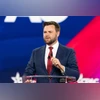 "Trump admin will keep 'ideological bias' out of AI: Vance at Paris summit")


