Currently, the value-added tax (VAT) in major gas centres like Delhi, Maharashtra, Gujarat, and Uttar Pradesh is nil, 13.5 per cent, 15 per cent, and 10 per cent, respectively, for piped natural gas (PNG), while an additional excise of 14.42 per cent is imposed on compressed natural gas (CNG).
Bringing natural gas under the goods and services tax (GST) may prove to be a double-edged sword, fear analysts. While it may help CGD firms to avail of input tax credit (ITC), it might also nudge them to raise CNG prices in cities like New Delhi. Nonetheless, increased gas usage would boost volumes.
Industrial users are also expected to benefit. “Industrial users currently cannot claim ITC for VAT paid on PNG. While this might not impact CGD margins directly, ITC claimed by end-users could improve economics by 5-13.5 per cent for industrial (users),” write Pratik Chaudhuri and Bhaskar Chakraborty of Jefferies.
Once gas comes under GST, manufacturers are likely to shift to it as a fuel.
Among gas utilities and producers, Emkay Global estimates a positive EPS impact from ITC of 7 per cent each on Indraprastha Gas (IGL) and Gujarat Gas (Rs 150 crore and Rs 140 crore Ebitda boost, respectively); 3 per cent for ONGC (Rs 77 crore); 7 per cent for Oil India (Rs 110 crore); and 9 per cent for GAIL (Rs 680 crore). Since the rate isn’t known, Emkay has assumed 15 per cent each for VAT and GST. Jefferies pegs EPS upside at 3 per cent, 4-5 per cent, and 7-8 per cent for Gujarat Gas, Mahanagar Gas, and IGL, respectively.
The retail price for consumers, too, will be determined by the final GST rate. However, since domestic PNG is a sticky segment it would not be affected. “Delhi with minimum taxation may see retail selling price hike, while for other states the 18-28 per cent GST range would be neutral on CNG and positive on PNG,” say Sabri Hazarika and Tanay Gabhawala of Emkay Global.
While most analysts are also bullish on Mahanagar Gas, there could be strong gains for Gujarat Gas in the immediate term.
Swarnendu Bhushan, senior VP, oil & gas analyst, Institutional Equities at Motilal Oswal Financial Services, believes the move would be beneficial for Gujarat Gas in the short term because of its high leverage to the industrial segment.
Over a longer period, better adoption would benefit GAIL, Gujarat State Petronet, and Petronet LNG.


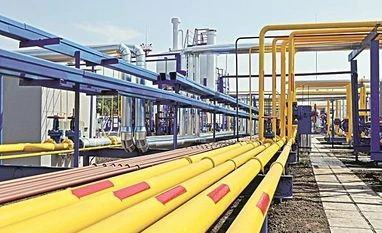 "GAS PIPELINE")