


It's time for auditors to upgrade themselves with AI to stay relevant
A Mckinsey Global Institute report suggests that AI is helping us approach an unparalleled expansion in productivity that will yield five times the increase introduced by the steam engine
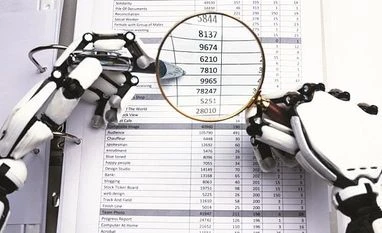 "It's time for auditors to upgrade themselves with AI to stay relevant")
premium
4 min read Last Updated : Dec 29 2019 | 6:06 PM IST
Artificial intelligence (AI) and the accounting professional are getting hyphenated! Without AI, machine learning (ML) and big data analytics (BDA), the profession cannot survive. The undercurrent is that external and internal data have to be juxtaposed to derive any valuable insight.
Consider the following example:
A company seeking to score the universe of corporates in India took a “trainer” set of 40,000 companies and put it through the paces of 55 variables obtained by “crawling” through public data. This “trainer” set was empowered by ML. A powerful, predictive model emerged! This model after a significant seasoning was used on another set of 20,000 companies. The model predicted defaults with a 77 per cent accuracy. Backtesting of a sample fully proved that the propensity to default was discernible. The application of these capabilities to various domains is left only to the imagination of a digitally oriented auditing and accounting professional (AAP).
Now stretch this logic further and consider how in the next 10 years the entire accounting and auditing activity may be disrupted. I can see productivity zooming.
A Mckinsey Global Institute report suggests that AI is helping us approach an unparalleled expansion in productivity that will yield five times the increase introduced by the steam engine and about 1.5 times the improvements we’ve seen from robotics and computers combined.
The idea of AI is not new, but the pace of recent breakthroughs is. Three factors are driving this acceleration:
ML algorithms have progressed in recent years, especially through the development of deep-learning and reinforcement-learning techniques based on neural networks.
Shailesh Hari Bhakti
Computing capacity has become available to train larger and more complex models much faster. Graphics processing units (GPUs), originally designed to render the computer graphics in video games, have been repurposed to execute the data and algorithm crunching required for ML at speeds many times faster than traditional processor chips. More silicon-level advances beyond the current generation of GPUs are already emerging, such as tensor units. This compute capacity has been aggregated in hyper-scalable data centres and is accessible to users through the cloud.
n Massive amounts of data that can be used to train ML models are being generated, for example through daily creation of billions of images, online click streams, voice and video, mobile locations, and sensors embedded in the internet of things (IoT).
Auditing is ripe for a Kurzweil DPU. This will express itself in a few years to bring about the following scene:
Aadhaar will connect all bank accounts, credit cards, internet activity, cell phones, and devices.
Every human (C) engaged in society will have an internet profile and every business (B) will have a visible and well-understood model. All intense interactions – B to B, C to C, C to B and step interaction such as B to B to C or B to C to B will have traceability and an inter counter-party footprint. The ecosystem connections will be so strong that the value retained by each of the economic agents can be tracked and modelled. Value, cost, price, and surplus will become transparent throughout the system.
Auditing will be embedded in the eco-system and will have largely a preventive role. Frauds, leakages unfair delays in payments, patterns or collusion will be prevented. The system will be self-learning and so will be able to detect any unusual arbitrage or rent-seeking activity. The simple detection and notification of such activities will automatically provide a natural incentive to reverse or not indulge in scammed upon transactions.
The ICAI and the Government of India will collaborate strongly to create the interfaces and the expertise to continually monitor the ecosystem. As consensus evolves along what activities to assign to auditors, how they should effectively conduct them, what may be done to attempted wrongdoings will follow and be AI-driven, ML-empowered growth path will make the ecosystem ‘SAFE’.
2020 will augur a complete move over to auditing using AI, ML, BDA, and blockchain. The auditing and accounting professional will have to disrupt himself/herself to remain relevant. Welcome to the New World!
The writer is a chartered accountant