


Home / India News / A backpacker's hub: Paharganj goes quiet under Covid pandemic blow
A backpacker's hub: Paharganj goes quiet under Covid pandemic blow
A backpackers' hub, its unique economy of hotels, restaurants, travel operators and money changers reels under Covid blow
 "Paharganj, Delhi, Market, Covid")
premium
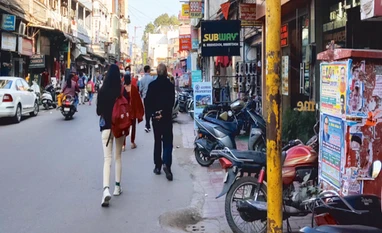
Paharganj, Delhi (Photo: Akshara Srivastava)
6 min read Last Updated : Dec 11 2021 | 6:05 AM IST
It is around 2.30 in the afternoon. Vivek Kanojia is carefully wrapping a ceramic wall hook that costs Rs 100 for his second customer of the day, Alina, who is from Russia. She is also the first foreigner to have stopped by his curio shop in a while. Two years ago, Kanojia would have already spent a few hours on his toes by this time of the day, attending to a steady stream of customers, most of them foreigners. “Now all I do is sit and dust my wares,” he says, looking at his stock glumly.
The street outside his shop is practically deserted. It is hard to believe that this is Paharganj, which is in ordinary times a vibrant tourist hub, both Indian and foreign — a place, perhaps, like no other in the country.
With its origins dating to the Mughal era, when the walled city of Shahjahanabad (present-day Old Delhi) spilled out to areas around, the modern-day Paharganj is recognised as a “hippie hotspot”. A hop across from the New Delhi Railway station, this is a unique economy that has thrived because of backpackers and budget or transit travellers.
But with the pandemic having curtailed travel, both international and domestic, this Delhi neighbourhood is now struggling to survive. Some would even say the last two-odd years have practically robbed it of its character, which is defined by its thousand-plus hotels, travel agencies, currency exchange booths and shops, and the host of restaurants serving cuisines from across the world.
The off and on travel restrictions have had a butterfly effect on Kanojia’s private life, too. Soon to be 28, Kanojia is unable to get married. “These two years have been so tumultuous. I can’t get married without being sure about my next salary,” he says.
Two shops away, hotel Sapna, which featured in Lonely Planet some years ago, has not seen international customers in two years. “The tourist business has completely stopped. So many tourists used to arrive in Paharganj from Poland, Japan and Russia,” says Jaswant Singh, its owner.
“Even small-time businessmen travelling to Delhi for work from different parts of the country would stay here. If they had work for two days, they would stay for four to see the city,” he says. “With Covid, even domestic travel has taken a hit.”
Paharganj is home to 1,200-1,500 hotels, most of which used to be fully occupied through the year.
Now, the bigger hotels, many of which are located by the main lanes, have slashed tariffs from Rs 1,200-Rs 1,500 per day to Rs 800 a day. Many of the smaller ones in the bylanes, which earlier charged Rs 800 a day, have shut shop.
Raman Sakhuja, a member of the Paharganj Market Association and owner of two hotels, says, “Business is down by over 50 per cent. It is not as though things started improving as restrictions were lifted. Maintenance costs are too high to keep up with. Electricity for commercial establishments is also very expensive; and even hotels that took down the power meters had to eventually pay their dues along with a fine.”
Sakhuja’s hotels, which had 100 per cent occupancy until two years ago, are now practically empty. The 21-room Hotel New Oxford Palace and 24-room Hotel Worth have barely five to eight rooms currently occupied. He, like the others, says there was no relief from the government.
At 4.30 pm, the market remains strangely quiet, interrupted only by a stray car horn. Somewhere a dog barks at a beggar who steps too close to him as he goes around asking for food.
Shyam Raje looks down from the second floor of his restaurant. Originally from Bihar, Raje has worked at almost all big tourist spots in the country. He was in Goa before he moved to Delhi in 2016 and established Arabian Shisha Café, which serves Uzbek and Russian food.
In the three years before the pandemic, the restaurant was a hit among international tourists craving the taste of home. The restaurant would also regularly supply food to people who were here in India for medical treatment and procedures.
“At the start of the pandemic, we supplied food to some Uzbek and Russian nationals who were stuck in India. But after they left, we have had close to no business in these two years,” says Raje.
“My restaurant survived because the landlord reduced the rent. Things were beginning to look up, but now with Omicron, international flights have again been suspended.”
Business is lukewarm, but he still comes to his restaurant. “I can’t sit at home. Coming to the restaurant gives me a sense of purpose. We get a few orders for home deliveries, but that is not a lot. I don’t think I will be able to pay rent this month either,” he says with a wry smile as he goes back to watching the highlights of a cricket match on his phone.
While he’s hoping things will get better, some others have decided to shut down their business and do something else.
Sidharth Dua is one of them. Dua set up a travel and ticketing agency in the market 20 years ago, and it grew and flourished rapidly. Then came the pandemic. Everything came to a standstill.
Unable to wait it out any longer, Dua took a loan three months ago and opened a general store. The board outside his shop, which reads “Travels and ticketing tour operator”, now has “Dua General Store” written in one corner. “<Kaam toh karna hai na> (I have to work). Grocery is one thing that will always be in demand, which is why it seemed like the best bet,” he says.
However, as he places an order for more Amul Taaza milk, he adds, “My main work is travel and tour operations, and I hope I can go back to it soon.”
Like Dua, Geetesh Kumari, who works at Baluja Forex Ltd, also borrowed some money as the family’s savings started running out, and opened a small grocery shop in her own home, selling essentials like milk, eggs and bread. “My 23-year-old daughter manages the shop now when I am at work,” she says.
Outside the colonial era single-screen Imperial Cinema, once a regular haunt of British babus that shut down in 2015, a rickshaw-puller offers someone a ride but is turned down. “Time hi aisa hai... poochna padta hai sabse (times are such… I have to keep asking everyone),” he says, with a weak smile, the desolate Paharganj reflected in his eyes.
Topics : Coronavirus Delhi government markets shut