


Home / India News / Domestic tourism builds morale at backpacker hub amid global crises
Domestic tourism builds morale at backpacker hub amid global crises
After Covid, Russia-Ukraine war has kept international travellers down to a trickle in Delhi's Paharganj
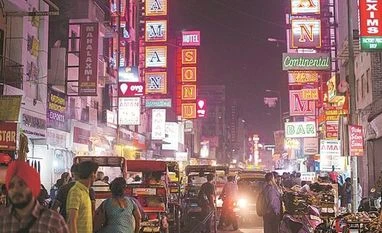 "New Delhi’s Paharganj")
premium
New Delhi’s Paharganj
5 min read Last Updated : Apr 08 2022 | 6:03 AM IST
Ohanna Le Gleinnec is enjoying a lazy lunch at a local eatery in New Delhi’s Paharganj. Since arriving in the capital five days ago, Gleinnec has been busy buying scarves and stoles. The French businesswoman sources clothes from India to sell them in her home country. This time she is back after a gap of two years, thanks to Covid.
“Things have changed so much since I was last here (in 2019),” she says. Back then, Paharganj, which is home to 1,200-1,500 hotels across various price points, used to be packed with international tourists.
“A lot of small shops and tea stalls, and even the café I used to frequent, have shut down. I guess they were the most affected by revenue losses. But a few new places, too, have propped up,” she says, pointing to a recently opened hair salon.
Gleinnec for one finds it refreshing that instead of foreigners there are now more locals to be seen in the area that is often described as a hippie hotspot.
The traders and business owners here are, however, not as enthused by this. They were hoping that the resumption of international flights on March 27 would bring back foreign tourists. But the Russia-Ukraine war has left them less optimistic about that happening anytime soon. A sizeable number of tourists to Paharganj is, after all, from that part of the world.
“It is our bad fate. Nothing else can explain this,” rues Shyam Raje, who runs Arabian Shisha Café, which serves Russian and Uzbek cuisines. His restaurant remains empty and barring stray orders from nearby hotels, there isn’t much to do all day.
“Most tourists to Paharganj were from countries like Russia, Ukraine, Uzbekistan, but the war has changed that,” says Rubein Manchanda, who runs a travel agency in the area. “Those who come now are here on business from countries like Spain and Israel. Their tickets are already booked (so they don’t need his services) and they also don’t need to exchange money since they use cards.”
Outside Manchanda’s travel agency, Or Pelle is asking for directions to Hare Rama Guest House. A businessman from Israel, Pelle sources incense sticks from India and sells them in his home country, where he will return by the end of this month.
As he starts walking while looking into his phone, an auto-rickshaw comes to a screeching halt, startling him. Today, there’s a lot more movement in the market than there was three months ago. But the crowd is made up of mostly locals.
While there is still barely a trickle of foreign tourists, a surge in domestic demand has helped Paharganj hotels recover some losses.
“Our occupancy has gone up by almost 30 per cent these past few weeks. But 90 per cent of it is driven by domestic demand only,” says a person at the De Cruise hotel, not wishing to be named. “But this has only helped us recover some of our losses, which have been running on for so long now.”
The hotel charges Rs 1,800 per night, but slashed rates to Rs 800-1,000 when it reopened in July 2021, smack in the middle of the pandemic.
At Magic Tree hotel, occupancy has touched 100 per cent — mostly driven by domestic demand, says the manager, Harpreet Singh. “Almost 60 per cent of people checking in are Indians who have travelled to Delhi for work,” he says. “Not a lot of people are vacationing right now. It is too hot for that. And, while occupancy is up, people are not staying for very long.”
Raman Sakhuja, member of the Paharganj Market Association, says the government must intervene and help “in ways like loan rebates and relief in house tax and the sky-high electricity charges”.
“The administration also needs to promote Delhi as a tourism hub,” he adds. “We see an increase in domestic demand for hotels, but it is either transit travellers or those who stay for work for a short period.”
This is true. While in Paharganj, it is common to overhear people talking about other destinations: Manali, Varanasi, Kasauli. For now, Paharganj, it seems, is just a cheap transit destination. Outside Sapna Hotel, a group of 20-somethings from Kerala is looking for affordable lodging. Their budget? “Rs 300 a day.”
“We’re here only for a day because we needed to rest after the long train journey. So, it doesn’t make sense to pay a lot. Tomorrow morning, we leave for Manali,” says a visibly excited Jo, who is travelling with three other friends.
“The problem is that they don’t see Delhi as a city they can explore,” says Sakhuja. “Every state has its own tourism advertisement. We need something like that for Delhi, too. It will be a great help to our sector as people will see the city as not just a central connecting point, but something more.”
That’s precisely what Paharganj needs at this point — something more.