


In swift follow-up action, Indian warship visits Indonesia's Sabang port
Delhi, Jakarta agreed in May to develop strategic port near Malacca
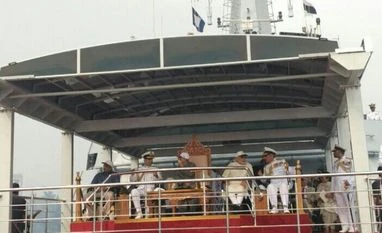 "Presidential ship INS Sumitra proceeds for fleet review. Photo: Twitter")
premium
Presidential ship INS Sumitra proceeds for fleet review. Photo: Twitter


On Wednesday, the Indian Navy patrol vessel, INS Sumitra, became the first-ever warship to sail into the Indonesian port of Sabang, strategically poised at the mouth of the Malacca Strait.
Underlining the importance New Delhi and Jakarta place on the visit, the vessel was welcomed to Sabang by traditional Indonesian dancers, Indonesian navy and air force officers, and Indian diplomats based in Jakarta, including the ambassador, P K Rawat.
This swift follow-up comes on the heels of thejoint announcement by Prime Minister Narendra Modi and Indonesia’s President Joko Widodo,in Jakarta on May 30,that an Indian-Indonesian joint task force would “undertake projects for port related infrastructure in and around Sabang.”
A fortnight before that, Luhut Pandjaitan, Indonesia’s minister for maritime affairs, on a visit to New Delhi to negotiate the agreement, noted that the 40 feet-deep port at Sabang was suitable for both civilian and military vessels, “including submarines.”
India is already building up the Andaman & Nicobar Islands as a tri-service command to watch over the eastern Indian Ocean, especially the Malacca Strait, the prime international shipping route through which merchant and military vessels transit between the Indian Ocean and the South China Sea.
But Port Blair, the headquarters of India’s Andaman and Nicober Command, is 500 nautical miles – almost 1,000 kilometres – from Sabang, in Banda Aceh. To exercise control over the Malacca Strait, the navy has at least one warship always on patrol in those waters. Access to Sabang Port will allow the navy to dominate Malacca more effectively.
Underlining the importance New Delhi and Jakarta place on the visit, the vessel was welcomed to Sabang by traditional Indonesian dancers, Indonesian navy and air force officers, and Indian diplomats based in Jakarta, including the ambassador, P K Rawat.
This swift follow-up comes on the heels of thejoint announcement by Prime Minister Narendra Modi and Indonesia’s President Joko Widodo,in Jakarta on May 30,that an Indian-Indonesian joint task force would “undertake projects for port related infrastructure in and around Sabang.”
A fortnight before that, Luhut Pandjaitan, Indonesia’s minister for maritime affairs, on a visit to New Delhi to negotiate the agreement, noted that the 40 feet-deep port at Sabang was suitable for both civilian and military vessels, “including submarines.”
India is already building up the Andaman & Nicobar Islands as a tri-service command to watch over the eastern Indian Ocean, especially the Malacca Strait, the prime international shipping route through which merchant and military vessels transit between the Indian Ocean and the South China Sea.
But Port Blair, the headquarters of India’s Andaman and Nicober Command, is 500 nautical miles – almost 1,000 kilometres – from Sabang, in Banda Aceh. To exercise control over the Malacca Strait, the navy has at least one warship always on patrol in those waters. Access to Sabang Port will allow the navy to dominate Malacca more effectively.
Access to Sabang Port will allow the navy to dominate Malacca more effectively photo: Reuters