


India saves 2 mn kids from dying, but 4 mn people go below nourishment line
Fall in GHI score is not absolute, but relative to other countries
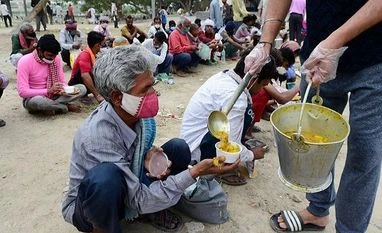 "Hunger, Homeless, coronavirus, migrant workers, charity, poverty, poor, covid-19, lockdown")
premium
The recently published Global Hunger Index (GHI) report says, “It is difficult to be optimistic about hunger in 2021.” And that’s an observation that applies to the entire world.
Though the GHI score for the world has fallen consistently in the last two decades, the pace of hunger eradication has slowed down in the last few years. The World GHI score fell from 28 in 1998-2002 to 25.1 in 2004-2008,to 20.4 in 2010-2014 and 17.9 in 2016-2020.
However, there are concerns that globally, the prevalence of undernourishment, or insufficient calorie intake, has risen in the last two years. And India is no exception.
Quick methodology
The four indicators used in calculating the GHI score are: The proportion of undernourishment — insufficient calorie intake; child mortality — percentage of children who die before turning five; prevalence of stunting — low height for age; and prevalence of wasting — low weight for height.
These parameters are in different units and not comparable to each other. In order to club them, they are standardised by giving a ceiling/floor to each parameter, and then converting the absolute value for a country to a value relative to the ceiling/floor.
The score is arrived at by taking the weighted average of the four parameters, in weights ratio 33.3:33.3:16.67:16.67 respectively, in the order mentioned above.
The final score lies between 0 and 100, zero being the best outcome possible in the current state of global hunger and 100 being the worst.
Fall in rank is relative to others
While India’s position has slipped in the GHI rank, its overall GHI score has actually improved in the last few years — from 28.8 to 27.5. Lower score translates to lower hunger.
Though the GHI score for the world has fallen consistently in the last two decades, the pace of hunger eradication has slowed down in the last few years. The World GHI score fell from 28 in 1998-2002 to 25.1 in 2004-2008,to 20.4 in 2010-2014 and 17.9 in 2016-2020.
However, there are concerns that globally, the prevalence of undernourishment, or insufficient calorie intake, has risen in the last two years. And India is no exception.
Quick methodology
The four indicators used in calculating the GHI score are: The proportion of undernourishment — insufficient calorie intake; child mortality — percentage of children who die before turning five; prevalence of stunting — low height for age; and prevalence of wasting — low weight for height.
These parameters are in different units and not comparable to each other. In order to club them, they are standardised by giving a ceiling/floor to each parameter, and then converting the absolute value for a country to a value relative to the ceiling/floor.
The score is arrived at by taking the weighted average of the four parameters, in weights ratio 33.3:33.3:16.67:16.67 respectively, in the order mentioned above.
The final score lies between 0 and 100, zero being the best outcome possible in the current state of global hunger and 100 being the worst.
Fall in rank is relative to others
While India’s position has slipped in the GHI rank, its overall GHI score has actually improved in the last few years — from 28.8 to 27.5. Lower score translates to lower hunger.