


Indian Army's forgotten hero, the Jonga, enjoys a cult following today
The Jonga served the army for over three decades, joining soldiers on the frontline during the 1965 and 1971 wars with Pakistan
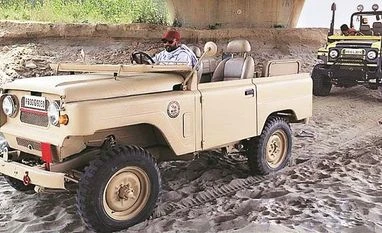 "Jongas restored by Jaswinder Singh Dosanjh")
premium
Jongas restored by Jaswinder Singh Dosanjh
One morning in 2007, Abhilash Nambiar was rummaging through a junkyard in Mumbai for Jeep spare parts when his eyes fell on a rusty vehicle in military colours parked in a corner. Could it really be the Jonga — the rugged warhorse of the Indian Army which he had only seen pictures of until that moment? It was.
The Mumbai resident spent the next nine hours convincing the scrap dealer to sell it to him, arranging for the tidy sum the man demanded, and then transporting the vehicle to the garage of his trusted mechanic in Thane. The next year passed in getting the 1977 model Jonga road-ready. Spare parts were extremely hard to come by as was expertise on how to restore the beast. Over the months, friends, acquaintances and strangers from as far as Chennai, Hyderabad and Kolkata offered advice and original parts. The day the engine cranked up, Nambiar rushed to the garage to witness the momentous event and drive the 4x4 for the first time. Though the army had retired it long ago, the old warrior was far from done. Ten years later, Nambiar, now 43, still swears by it.
There is a reason the Jonga incites such passion. “The Jonga was the Indian Army’s unique and one of the last built-to-a-purpose vehicles. It served as a personnel carrier, an ambulance, a reconnaissance vehicle and also as a carrier for the anti-tank recoilless rifle,” says Gurugram-based Anil Singhroha, who retired as colonel from the Mahar Regiment. As a newly-commissioned officer in 1994, he first learned to drive on the Jonga.
The Jonga’s story begins in 1960, when Nissan introduced a new four-wheel drive vehicle. Nissan called it P60, for Petrol 60. In 1963-64, the P60 was inducted in the Indian Army, which also took over its production and gave it a name — the Jonga, an acronym for Jabalpur Ordnance and Gun Carriage Assembly after the Vehicle Factory Jabalpur, the facility tasked with building it.
The Mumbai resident spent the next nine hours convincing the scrap dealer to sell it to him, arranging for the tidy sum the man demanded, and then transporting the vehicle to the garage of his trusted mechanic in Thane. The next year passed in getting the 1977 model Jonga road-ready. Spare parts were extremely hard to come by as was expertise on how to restore the beast. Over the months, friends, acquaintances and strangers from as far as Chennai, Hyderabad and Kolkata offered advice and original parts. The day the engine cranked up, Nambiar rushed to the garage to witness the momentous event and drive the 4x4 for the first time. Though the army had retired it long ago, the old warrior was far from done. Ten years later, Nambiar, now 43, still swears by it.
There is a reason the Jonga incites such passion. “The Jonga was the Indian Army’s unique and one of the last built-to-a-purpose vehicles. It served as a personnel carrier, an ambulance, a reconnaissance vehicle and also as a carrier for the anti-tank recoilless rifle,” says Gurugram-based Anil Singhroha, who retired as colonel from the Mahar Regiment. As a newly-commissioned officer in 1994, he first learned to drive on the Jonga.
The Jonga’s story begins in 1960, when Nissan introduced a new four-wheel drive vehicle. Nissan called it P60, for Petrol 60. In 1963-64, the P60 was inducted in the Indian Army, which also took over its production and gave it a name — the Jonga, an acronym for Jabalpur Ordnance and Gun Carriage Assembly after the Vehicle Factory Jabalpur, the facility tasked with building it.
Abhilash Nambiar with his restored 1977 model Jonga