


Kickstarting Kashmir's economy will be PM Narendra Modi's next challenge
Greater influx of labour and capital from rest of India will enable Kashmir and Kashmiris to come out of their economic rut
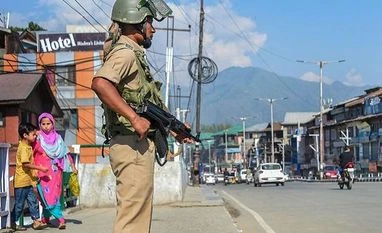 "A CRPF jawan stands guard as situation in Kashmir continues to be tense and uncertain, in Srinagar, Sunday, Aug. 4, 2019. There are apperhenensions of prolonged law and order problem in the Valley | Photo: PTI")
premium
A CRPF jawan stands guard as situation in Kashmir continues to be tense and uncertain in Srinagar. | Photo: PTI
With Article 370, which gave special status to Jammu & Kashmir, now abrogated, the doors to development in the troubled Union Territory that has long been stuck in an economic rut despite its abundant natural resources, business potential and tourism avenues could finally be thrown open to one and all. An average Kashmiri earned just about Rs 5,000 a month in 2016-17, almost half of what an average Indian earned every month. While there is no visible poverty in Kashmir owing to strong community bonds, the state has been stuck in an economic rut if Reserve Bank of India (RBI) data is anything to go by. An average Kashmiri still earns considerably more than other poor states of India like Bihar, Uttar Pradesh and Madhya Pradesh. But since 2004-05, these poor states, or the BIMARU states, have seen much sharper increases in their per capita income than Jammu and Kashmir. While the average income of Indians increased almost four fold during the last decade and a half, residents of Jammu and Kashmir saw their per capita incomes increase by two and a half times during this period. This put them at par with certain north eastern states like Nagaland, Mizoram and Meghalaya, but better than some other states like West Bengal. Clearly a state, which has tremendous business potential owing to its diverse geographic landscape that include the plains of Jammu division and the natural resources of Kashmir division, hasn’t progressed with the rest of India. Even if the new base year (2011-12) is taken into consideration, the per capita income of a Kashmiri has risen by just 17 per cent from 2011-12 to 2016-17. Residents in other parts of India have seen their incomes rise at twice this rate.