The Budget has allocated around Rs 4.22 trillion for food subsidy. Of this, FCI’s share is around Rs 3.44 trillion. The rest is meant for making payment to decentralised procurement states.
Of the FCI allocation, around Rs 2.18 trillion will go towards clearing the National Small Savings Fund (NSSF) loans. Even after that, around Rs 1.26 trillion of NSSF outstanding loan will have to be cleared by the FCI.
A source pointed out that the Centre would need to provide another Rs 1.5 trillion to meet FCI's subsidy requirement, besides Rs 30,000-40,000 crore for decentralized procurement states every year to manage the expenses and dues. Officials have also warned against off-budget borrowing as has been the practice in the recent years.
“FCI usually gets around 95 per cent of the Budget requirement in a given financial year while the remaining is transferred after the books are audited. But for the last few years, just 50-55 per cent of this was given as budgetary support while for the rest we had to borrow from the NSSF,” a senior official explained. This resulted in the interest burden piling up to almost Rs 30,000 crore from Rs 5,000 crore earlier.
The subsidy burden is incurred primarily due to distribution of around 60 million tonnes of grains at subsidized rates of Rs 3 per kg for rice, Rs 2 per kg for wheat and Rs 1 per kg for coarse cereals.
An official said a one-rupee increase in the central issue price of grains could lower the food subsidy by almost Rs 6,000 crore annually. But it’s a political call, he added.
The 2020-21 Economy Survey recommended increasing the CIP of grains to cut the rising food subsidy.
For procuring mountains of grains, FCI does not incur any subsidy directly. But, the interest that FCI pays every year on its borrowing forms part of the economic cost which is used to calculate the final subsidy burden.
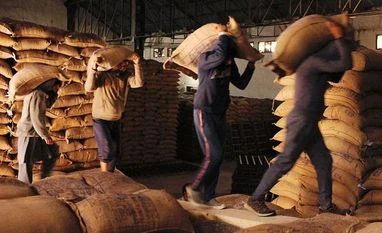
Every year, FCI needs around Rs 1 trillion as working capital to meet its procurement of around 80 million tonnes of grains against a requirement of around 60 million tonnes. The surplus is carried over, adding to the overall cost.
Experts are now advocating adequately incentivising farmers to shift from growing paddy and wheat towards more lucrative crops to control the subsidy.
According to former FCI chairman Alok Sinha, stopping open-ended procurement is not feasible. But, getting farmers to move to lucrative crops through incentives could be a way forward.


 "Budget may help pare FCI dues, but risk of cost overrun remains")

