


Ganga pollution rose in Uttarakhand in 2014-18, no change in UP, Bihar, WB
A Central Pollution Control Board report showing this was put in public domain only after Supreme Court directions but withdrawn within 12 hours of questions being sent to the govt for this story
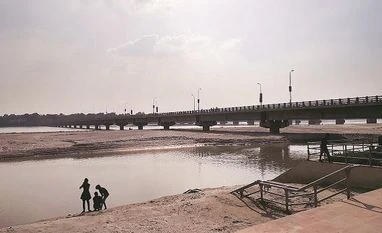 "ganga")
premium
In June 2014, the Union government approved the Namami Gange project under the National Mission for Clean Ganga (NMCG) as a comprehensive mechanism to take up initiatives to check pollution and rejuvenate the river and its tributaries
After coming to power, the National Democratic Alliance (NDA) government made cleaning of the Ganga one of its top priorities. It renamed the Ministry of Water Resources as the ‘Ministry of Water Resources, River Development and Ganga Rejuvenation’ and launched the ‘Namami Gange Programme’ “to accomplish... effective abatement of pollution, conservation and rejuvenation of National River Ganga” with an outlay of Rs 20,000 crore in its first Budget. Since then, it has already spent more than Rs 6,100 crore on the programme.
But have the government efforts improved the quality of water in the Ganga?
A recent report by the Central Pollution Control Board (CPCB), which the government has put under wrap for several months, shows that the Ganga became more polluted along its stretch in Uttarakhand between 2014 and 2018, while in the remaining stretch in Uttar Pradesh, Bihar and West Bengal it remained as polluted in 2018 as it was in 2014.
The CPCB scientists classified the Ganga’s water quality into five categories — clean, slight, moderate, heavy and severe — in the increasing order of pollution. They conducted pollution monitoring at 36 locations along the stretch of the Ganga in two seasons — before and after monsoon — in 2017-18. They then compared the water quality at 23 of these locations for which data were also available for 2014-15.
“The average biological water quality, according to the biological testing study of River Ganga conducted during past three consecutive years (2014-15, 2015-16 and 2017-18) in Uttar Pradesh, Bihar and West Bengal states remained the same i.e. moderately polluted. In the Uttarakhand stretch, average biological water quality reflects deterioration from slight to moderate pollution,” said the CPCB report.
According to the report, in Uttarakhand, though the water quality improved by one degree (from slight to clean) at one location in Haridwar, between 2014 and 2018, it deteriorated by four degrees (from clean to heavy) at another site, Jagjeetpur, during the same period. The scientists concluded that overall there was a deterioration in the quality of the river within the state.
In the remaining stretch, water quality improved by one degree (from heavy to moderate) at one location in Moradabad, deteriorated by one degree (from slight to moderate) at a location in Allahabad, and remained unchanged at ‘moderate’ pollution levels at 18 other locations in Bijnour, Muzaffarnagar, Anupshahr, Narora, Badaun, Ghatia Ghat, Bithoor, Kanpur, Fatehpur, Varanasi, Patna, Behrampore, Srirampore and Belgharia. The report, thus, concluded that the pollution level remained the same in the remaining stretch of the Ganga. In some cities, monitoring was done at more than one locations.
But have the government efforts improved the quality of water in the Ganga?
A recent report by the Central Pollution Control Board (CPCB), which the government has put under wrap for several months, shows that the Ganga became more polluted along its stretch in Uttarakhand between 2014 and 2018, while in the remaining stretch in Uttar Pradesh, Bihar and West Bengal it remained as polluted in 2018 as it was in 2014.
The CPCB scientists classified the Ganga’s water quality into five categories — clean, slight, moderate, heavy and severe — in the increasing order of pollution. They conducted pollution monitoring at 36 locations along the stretch of the Ganga in two seasons — before and after monsoon — in 2017-18. They then compared the water quality at 23 of these locations for which data were also available for 2014-15.
“The average biological water quality, according to the biological testing study of River Ganga conducted during past three consecutive years (2014-15, 2015-16 and 2017-18) in Uttar Pradesh, Bihar and West Bengal states remained the same i.e. moderately polluted. In the Uttarakhand stretch, average biological water quality reflects deterioration from slight to moderate pollution,” said the CPCB report.
According to the report, in Uttarakhand, though the water quality improved by one degree (from slight to clean) at one location in Haridwar, between 2014 and 2018, it deteriorated by four degrees (from clean to heavy) at another site, Jagjeetpur, during the same period. The scientists concluded that overall there was a deterioration in the quality of the river within the state.
In the remaining stretch, water quality improved by one degree (from heavy to moderate) at one location in Moradabad, deteriorated by one degree (from slight to moderate) at a location in Allahabad, and remained unchanged at ‘moderate’ pollution levels at 18 other locations in Bijnour, Muzaffarnagar, Anupshahr, Narora, Badaun, Ghatia Ghat, Bithoor, Kanpur, Fatehpur, Varanasi, Patna, Behrampore, Srirampore and Belgharia. The report, thus, concluded that the pollution level remained the same in the remaining stretch of the Ganga. In some cities, monitoring was done at more than one locations.