


This UP school shows how remedial classes can end India's education crisis
One of the reasons why remedial classes are successful is because the teacher is equipped to teach students of different grade levels in one single class
 "India ranks 115 in World Bank's Human Capital Index; govt dismisses report")
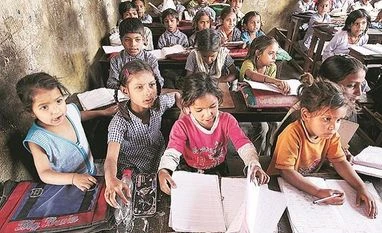
“Nal itna baha, itna baha, ki weh le gaya bus, cup aur mala,” (The tap flowed, it flowed so much that it took with it a bus, a cup and a necklace) read out Bhagchand, a grade V student. He then explained the meaning of the poem.
This is a government school in Chandera, a village of about 200 households, mostly labourers and farmers, in Uttar Pradesh’s Lalitpur district, which lies on the border with Madhya Pradesh. These children are part of a remedial education programme for government schools called Aparajitha (one who cannot be defeated), which aims to help children up to grade V to improve their reading, writing and comprehension skills. Aparajitha is run by World Vision, an international nonprofit that works in several states across India.
“There are about 220 days in a school year which means primary school children have a total of 1,000 days by the end of class five to learn,” said Liju Varkey Jacob, who manages Lalitpur’s World Vision branch, emphasising how critical the early years of a child’s life are.
India has been successful in increasing primary school enrolment to the extent that more than 83% of primary school-age children were enrolled in 2016-17, according to data from the District Information System for Education (DISE). But fewer than half (47.8%) of grade V rural students could read at least a grade II text in 2016, the Annual Survey of Education Report 2016 found. This learning crisis does not bode well for India’s young school population--about 22% of India’s entire population, and its future citizens.
A programme such as Aparajitha, which reaches 4,300 students in 130 villages in Lalitpur, could be one way to help students improve their learning outcomes. Its 3,683 students who enrolled in financial year 2017 display progress on the programme’s reading scale, as per World Vision data, and the programme is widely accepted in the community, our reporting found.
From a zero baseline, within a year 1.55% of enrolled students could read local content (such as newspapers) and understand it; 6.2% (up from 1.8%) could read a story and comprehend it; and 10.4% could read a story (up from 5.1%).
Further, 13.8% of students could read a paragraph (up from 7%); 29.5% could read words (up from 16.9%); and fewer could only read letters (43.9% v. 32.9%) or read nothing at all (5.6% v. 25.1%).
To study the impact of the programme, World Vision also studied a control group of students who did not take remedial classes, but had the same socio-economic characteristics as those enrolled. They found that more students enrolled in the programme progressed through the six levels than in the control group, but are yet to conduct a thorough statistical analysis to prove their findings conclusively. Nevertheless, in our reporting, we found that teachers valued the programme and the improvement in children’s abilities, there was widespread support from the community, and the children clearly enjoyed the classes.
Why remedial education
India has achieved almost universal primary school enrolment, mostly by motivating parents and increasing the number of primary schools even in the remotest of areas. This was aided by the growing perception that education improves the quality of life. But the major challenge in education today--poor learning outcomes--will be more difficult to solve.
This is at the core of World Vision’s plethora of interventions in Lalitpur, including scholarships for older children; support to school management committees which include parents; aid for teachers; and outreach programmes for parents. The experience with the remedial classes suggests several prerequisites: Pre-education (before a child starts grade I, as for instance in kindergarten), multigrade teaching (for when students of different ages and grade levels study in the same classroom), and support and training for teachers. “Even though we have been working here since 1997, we haven’t succeeded 100%,” Jacob said.
“The community, teacher and child have to work together to improve learning else the impact of school is much less,” said Ashish Mishra, 36, an upper primary government schoolteacher, who also helps train other teachers in Lalitpur district.
Government school students more vulnerable
Bhagchand, 10, who goes by one name, first attended classes in October 2016 when he was in grade III. He could read words at that time, and was classified as a Level 2 student on the World Vision scale, which meant he could read words. By March 2018, he had progressed from reading words to sentences to a story.
“I like coming here,” he said. “It’s a lot of fun and the other children help me too.” Volunteers at the remedial classes are trained to teach using fun ways, that government schools do not usually use. Once a week they also hold what is called a ‘life skills class’, in which volunteers use stories and games to teach soft skills such as hard work, teamwork and the need for anger control.
In one such class, teacher Dwarka Prasad Niranjan was teaching the students teamwork--three students had to work together, with one using sign language to guide the second to a duster, and the second having to explain the directions verbally to the third, who was blindfolded. The class rang with peals of laughter.
“We know that children imitate these games back home and in the village too. The power of teaching through play is far greater than through rote learning or traditional teaching,” Niranjan said.
Bhagchand needs all this extra guidance. His parents, Asharam and Ramdhakeli, both of whom are daily labourers, never went to school and could not help him with his studies at home. “We don’t know anything,” Asharam said, adding they were not even sure which class their son was in, asking one of his friends standing nearby. The only little help he got at home was from his older sister, Sushma, who studies in grade IX. “If he studies, his fortunes will be bright,” Asharam said.
Generally, children enrolled in private schools are from richer, smaller families in which parents devote more attention, often pay for supplemental education, and have better home environments, according to a study by Wilima Wadhwa, a researcher with Pratham, the nonprofit that manages ASER. Children in government schools are often those most in need of an education outside the home.
Overall, government school enrolment has been falling, according to DISE, the government education database. In 2007-08, 27.6% of children across India attended private schools; in 2016-17, 38.5% did. Parents mentioned several reasons for the decision to send children to private schools, including the perception that children will learn less in government schools, and that they will have better English-language education in private schools, as IndiaSpend reported in February 2017.
“It is in government schools that there is the greatest need for good teachers. Parents can’t get homework done or check what the child has done in school,” said Vibha Kumari, 43, who has taught for the past three years in another government school in Lalitpur. She said her students often have incontrovertible reasons for not doing their homework--from having had to help the parents pick mahua fruit, to having to take care of a younger sibling, to parents’ getting a poor price for their produce so being unable to buy a notebook.
Teachers have to go above and beyond their duties to help the most vulnerable students. “If a child has torn clothes and their parents cannot take time out from putting food on the table, we even sew their clothes,” Lalkunwar, 34, another government schoolteacher, said.
Programmes such as World Vision’s are most relevant for such students, providing remedial education focusing on government primary school students and providing support to government schoolteachers.
Training teachers, and pre-school education
One more reason why remedial classes are successful is because the teacher is equipped to teach students of different grade levels in one single class, as government schoolteachers are often called-upon to do. As many as 17.5% of all teaching positions in government elementary schools were vacant as of March 2016, according to this response to a query in the Lok Sabha, the lower house of parliament.
Lalitpur too has a teacher shortage, said Harsh Chand and Ashish Mishra, government schoolteachers and teacher trainers. Teachers need to be trained to teach several grades, varying age groups and different educational levels in one class, they said. Teachers also need more support throughout the year to be able to solve problems that arise, added Ghanshyam Das, a schoolteacher in Chandera village.
The other gap that the remedial education classes are filling is in teaching children at the level they are and not at their grade level--a need that arises because children often start school at a learning level lower than that expected, and keep falling further behind as time passes. “Pre-education is literally zero. Class I is a child’s launching pad but the government’s course is made such that they assume children attended kindergarten. How does one expect these children to start with a poem as the first chapter?” said Jacob of World Vision.
The government should either ensure that children attend kindergarten or anganwadis (day care centres), or that the school syllabi are redesigned keeping in mind that class 1 is the first time some children attend school, said Ghanshyam Das, a teacher at the Chandera government school.
Creating role models
Lalitpur is mostly rural, and historically has low literacy rates, especially for women. “Someone jokingly said that for young women there are two local role models--Rani of Jhansi, the queen who fought a battle against a British takeover in 1858, and Phoolan Devi, the gangster,” said Jacob, highlighting the need for role models and success stories to inspire children and parents.
The remedial education programme hopes to fill this void, both through its trainers who have earned the community’s respect, and through World Vision’s success stories from other programmes.
Sapna, 23, one of the first women to venture out of her village Baroda Bijlon for education and work, started working as a nurse in a government hospital in Jhansi on July 10, 2018. She was part of a cohort of 21 that World Vision had supported through a nurse training course. Her parents are farmers. Her father had dropped out of school after grade V and her mother is illiterate, she said.
Having recently got married, Sapna said she was sure she would continue to work. “We have agreed that I will work after marriage,” she told IndiaSpend, dressed in a pair of blue jeans, paired with a black-and-grey t-shirt and a light-blue scarf, her forehead marked with a red bindi and sindoor in her hair parting. “I’ve studied hard to become a nurse, why would I not work?”
Sapna made it against all odds in rural Lalitpur, where just over half the female population (59.2%) above the age of six years has attended school, and 61.1% of women of 20-24 years were married before the age of 18, according to the fourth National Family Health Survey (NFHS).
These successes are an inspiration for students to continue studying and for parents to enrol children in school, Jacob said.
Exit strategy
The success of an NGO’s intervention rests to some extent on whether the programme and its outcomes last after the NGO exits the community. World Vision will wrap up its operations in Lalitpur by 2020, and it will be up to the local community and schools to take forward the work. The programme’s low cost--Rs 1,064.94 per child per year for the 10-month programme, equivalent to a meal for two people at an urban restaurant--and the fact that all teachers are hired and trained locally should make it easier to do so.
“We are working on a transition plan,” said Jacob. Currently, the NGO is trying to convince the community to provide 50% of the funds needed to run the programme in 2019, which they believe will build community ownership for the programme before 2020. The government’s school funds--roughly Rs 10,000 per school per year--could also be used. The NGO is also training government teachers to take over the programme.
Reprinted with permission from IndiaSpend.org. Read the original article here