


In Russia's invasion of Ukraine, here are the good, bad and ideal refugees
Russia's invasion of Ukraine has already caused two million refugees to flee the country. The UNHCR predicts that another four million will be displaced if the conflict continues
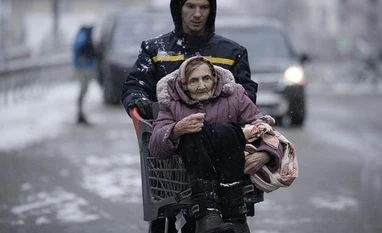 "Ukraine russia")
An elderly lady is carried in a shopping cart after being evacuated from Irpin, on the outskirts of Kyiv, Ukraine, Tuesday, March 8, 2022. (AP Photo/Vadim Ghirda)
Although all neighbouring European Union countries have pledged to accept refugees from Ukraine, as people flee across borders, a complicated story emerges of who are perceived and received as good, bad and ideal refugees in modern Europe.
Take Poland — a country that is being praised globally for accepting over one million refugees from Ukraine — only months ago it was condemned for serious human rights violations after engaging in pushing back and firing tear gas at asylum seekers and migrants from the Middle East and Africa driven to the border by Belarusian forces.
How can we address these clear refugee protection gaps for Black and brown people at borders while still recognizing the tremendous efforts neighbouring countries are putting forward to those displaced?
A convention designed for war
The 1951 Refugee Convention was initially created to protect European refugees in the aftermath of the Second World War. It defines a refugee as a person who has fled their country because of a well-founded fear of persecution on one of five grounds: race, religion, nationality, membership of a particular social group or political opinion.
During war, everyone in the invaded country has a well-founded fear of persecution. Non-refoulement states that no one should be returned to a country where they would be in danger of being subjected to violations of certain fundamental rights.
Over the past 50 years, the conventions relevance has been questioned. It is hard to see it as relevant when European countries close their doors to refugees fleeing conflict from Afghanistan and Syria but open them to Ukranians.
Political theorist Steven Lukes argues that disasters, like wars, can be transformative or confirmatory as they provide an opportunity to examine the “exception” to better understand “the rule.”
What’s happening in Ukraine has unveiled the existing hierarchy of refugees that exists in modern Europe as portraits of the good, bad and ideal refugees emerge.
The good refugees
Mainstream depictions of refugees are quite generic and often comprise images of dark-skinned victimized women and children. But coverage on Ukrainian refugees has focused heavily on Ukrainian-born refugees, not all refugees from Ukraine.
Ukrainian refugees have been described as “white,” “intelligent,” “educated,” “civilized,” “middle-class,” “well-dressed” and, most importantly, unlike refugees from “Iraq or Afghanistan.”
A clip from Al Jazeera described Ukrainian refugees boarding a train: