


When Donald Trump's tweets are angry, the mood of his followers darkens
His tweets show his supporters what he is thinking, directly and unvarnished
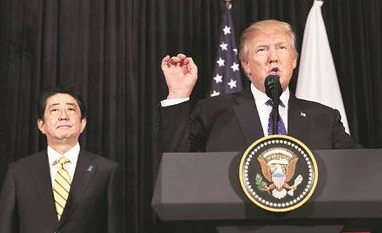 "Donald Trump, Shinzo Abe")


President Donald Trump has shown a unique ability to use Twitter as a way to connect directly with his followers.
His tweets show his supporters what he is thinking, directly and unvarnished. Less well appreciated, but apparent in our research based on new polling, is how Trump’s anger and its targets are quickly adopted and internalized by large numbers of his followers. What he says, they say. What he believes, they believe.
How is it that Donald Trump’s tweets have this kind of power? I contend that much of the explanation is in the power of memes.
Leaping from brain to brain
A meme is an idea, a catchphrase – “read my lips” – or even a tune or image that has grown into a cultural phenomenon. Richard Dawkins in “The Selfish Gene” called a meme “a new kind of replicator” which leaps from “brain to brain” with a speed that we humans have not seen before. Dawkins recognized that in the new millennium, within the “nutrient-rich culture” of the internet, memes spread virally.
The internet allows all kinds of misinformation to spread. There was, for example, the widely publicized story that a Jewish couple in Pennsylvania had to pull their child from school because they were blamed for the cancellation of the school’s holiday play.
Memes are not restricted to liberals or conservatives. But they can, I contend, help us understand the connection between Trump and his supporters. They explain the way falsehoods develop through conservative media, are amplified through his tweets and are replicated in the words and thoughts of his followers.
Intuitively, you may have suspected that this had been happening. But a unique type of poll from Penn State’s McCourtney Institute for Democracy allowed us to begin tracking the development and transmission of these memes.
How the poll works
Along with Eric Plutzer, the poll director and a professor of political science and sociology, I have been working for many years on the link between public opinion and public policy. The new McCourtney Institute’s Mood of the Nation Poll is a scientific internet-based survey conducted for us by YouGov that poses a series of open-ended questions to a representative sample of 1,000 Americans.
Rather than selecting from a predetermined set of answers, half of the sample was asked to tell us in their own words what in politics made them angry or proud. The other half was asked about what in the news made them angry or proud. Answers to both prompts are combined in this analysis. All respondents were also asked what, looking ahead, made them hopeful and worried. Their responses give us a unique opportunity to witness the ways in which the public is imitating Trump.
The most recent poll took place one week after Election Day in November 2016. This was in the immediate aftermath of protests that erupted after the election and which continued for several days at colleges, universities and major cities across the country. In response, just two days after his election, Trump tweeted: