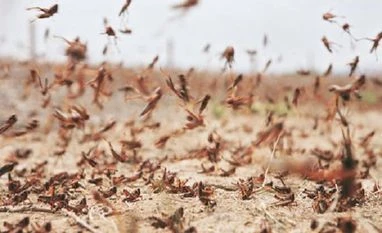
What is truly worrisome for India is the unabated breeding of locusts in Iran and Pakistan. Some of these pernicious pests have landed in the Fazilka area of Punjab and Sri Ganganagar district of Rajasthan. Earlier, these were spotted in the border regions of Gujarat and Rajasthan, where they annihilated nearly 170,000 hectares of wheat, mustard, and cumin. Unlike Covid-19, whose dispersal can be curtailed by sealing the area, locusts can be kept at bay only by killing them wherever they are as they do not recognise geographical boundaries. This requires multi-nation action. The United Nations Food and Agriculture Organization (FAO) has, in the past, been spearheading such international campaigns quite admirably. But this time, even this body is feeling handicapped due to a Covid-induced resource crunch and the resultant inadequate cooperation from the equally resource-deprived locust-affected nations.
Going by the prognosis of the locust-monitoring agencies, fresh swarms of this pest, emanating from Africa and parts of Asia, might land in the Indian subcontinent in May or June and gather further strength during the monsoon season. A locust stream from East Africa could take the land route, traversing Yemen, Bahrain, Kuwait, Qatar, Iran, Saudi Arabia, and Pakistan, to reach Punjab, Haryana, and other parts of the highly fertile Indo-Gangetic agricultural belt. Another stream could possibly make its way directly to peninsular India, crossing the Indian Ocean. These pests can devour crops, plantations, and any other vegetation that they come across.
Thankfully, India has not been caught unawares. The agriculture ministry claims to have stepped up vigilance against this peril. More importantly, wiser senses have prevailed in Pakistan as it has, despite the current tension with India, continued mutual negotiations on this issue under the aegis of the FAO. But that does not automatically guarantee any result-oriented joint action to outsmart this common foe. Pakistan is facing an unparalleled economic crisis, worsened due to Covid-19, which has dented its capacity to play its due role in the anti-locust drive. That increases India’s burden on this count. New Delhi, therefore, needs to begin preparing for it right away. The need is to build up the stock of locust-specific pesticides and equipment for ground and aerial spraying, especially large pesticides sprayer aircraft, which are not easy to find in large numbers. Laxity on this front can prove costly. For, the country can ill-afford any loss of crops or livelihood at this juncture when a sizable section of population has been rendered jobless due to Covid-19 pandemic and needs food doles to survive.


 "Locust")