From this steady trajectory of export prosperity till just two years ago, the country faced a balance of payments crisis, forcing it to approach the International Monetary Fund for a $4.5-billion bailout package, the third South Asian nation to do so in the recent past. Prime Minister Sheikh Hasina’s government has blamed the pandemic and the Russian invasion of Ukraine for the sharp economic downturn that has crimped global demand and seen a surge in inflation, adding to the woes of ordinary Bangladeshis. Though this explanation is valid, the country’s precipitate decline is also a compelling indication of the shaky foundations on which its success has been built, a fact that the resurgence of the BNP ahead of elections next year has underlined. The basis of the country’s export success story has been pinned to the advantages of low-cost labour rather than a meaningful move up the value-addition chain. Ready-made garments account for over 80 per cent of its exports. The risks of this overwhelming reliance on a single item were underlined during the pandemic; when global demand slumped, Bangladesh had no buffers. Indeed, in the absence of a dynamic domestic economy built on a wider economic base, skilled labour, and efficient infrastructure, Bangladesh is likely to struggle to attain its ambition of reaching upper-middle income status by 2031.
A significant reason for the country’s inability to grow beyond its structural limitations is the authoritarian nature of the ruling regime, which is intolerant of criticism. Ms Hasina has held power since 2009, no mean feat in a country that was once dominated by the military. But over the years, she squandered the country’s export surpluses on vanity projects and her rule was increasingly marked by accusations of electoral fraud, extra-judicial killings of critics, a rigged judiciary, and arbitrary arrests. Recent revelations of corruption against a business house founded by a relative of an Awami League leader have not helped the ruling regime’s case. The absence of stable institutions, a social security system, the rule of law, and general good governance have all meant that Bangladesh can scarcely be considered an environment conducive to the kind of business investment that can stabilise the economy in the long run even as the country’s geography puts it on the frontline of the climate change crisis.


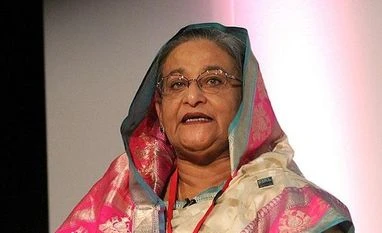 "Bangladesh PM Sheikh Hasina | Wikimedia Commons")