


Ecological crisis: Point of no return?
We must promote a comprehensive ecological convention that addresses all interconnected parts of ecology and not just climate
 "climate change, global warming, sea level")
premium
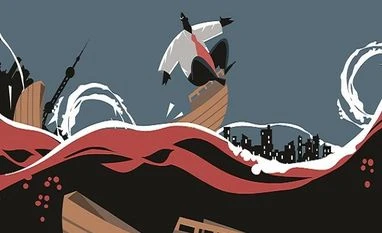
Illustration by Binay Sinha
This summer has seen massive forest fires in the temperate zones of Europe and America. Temperatures in Spain have touched 47 degrees Celsius, which are more associated with Rajasthan’s desert regions than Europe. Unprecedented floods have ravaged parts of Japan. The scale and frequency of extreme climatic events like cyclones and typhoons have increased the world over. Global warming is accelerating with 17 of the warmest years on record having occurred since 2001. The melting of ice sheets and glaciers has also gathered momentum. According to NASA, ice losses from Antarctica have tripled since 2012, increasing sea levels by 3 mm just in this short span of time. At the global level, NASA estimates that before 2012, the world’s glaciers and ice sheets were being lost at the rate of 76 billion tonnes per annum. Since 2012, the loss is at the rate of 219 billion tonnes per annum. The rate of sea-level increase has therefore doubled to 0.6 mm per year from 0.3 mm per year on an average globally. To put this in perspective, if all the ice which currently lies locked in ice sheets on Antarctica were to melt and flow into the oceans, sea levels would rise by 58 metres and most of the major cities of the world, its coastal plains and islands would cease to exist.
Global warming is linked to the density of accumulated greenhouse gases, mostly carbon dioxide, in the earth’s atmosphere. The current density, according to NASA, is 408 ppm (parts per million). It was estimated to have been 280 ppm before our current industrial age began. Average global temperature has increased by one degree Celsius compared to 1880 and scientific consensus holds that if temperatures were to increase beyond 2 degrees Celsius, there could be catastrophic and possibly irreversible changes in our planet’s fragile ecology. Although there is some ambiguity over the density of carbon emissions associated with the 2-degree temperature rise, a figure of 480 ppm is generally accepted by climate scientists. This would imply that the world could add another 72 ppm to the existing stock of carbon dioxide in the atmosphere before an irretrievable ecological crisis erupted. But it appears that even with a one-degree rise we may already be in the midst of a crisis. The dystopian future may already be upon us. This is because the change in climate is also interacting with the large-scale and worldwide environmental degradation. Our oceans are dying from the millions of tonnes of non-degradable plastics being dumped into them. Our forests are being denuded and our rivers are turning into chemical sewers. The mountains of urban waste have become dangerous stores of methane which has a much higher global warming impact than carbon dioxide. There is thus a strong feedback loop between climate change and environmental degradation, which intensifies the consequences of both. One is not even taking account of other alarming developments in the planetary ecology. Nearly 20-30 per cent plant and animal species evaluated in recent climate change research are threatened with extinction, both due to human encroachments into and changes in their habitats due to temperature rise.
Global warming is linked to the density of accumulated greenhouse gases, mostly carbon dioxide, in the earth’s atmosphere. The current density, according to NASA, is 408 ppm (parts per million). It was estimated to have been 280 ppm before our current industrial age began. Average global temperature has increased by one degree Celsius compared to 1880 and scientific consensus holds that if temperatures were to increase beyond 2 degrees Celsius, there could be catastrophic and possibly irreversible changes in our planet’s fragile ecology. Although there is some ambiguity over the density of carbon emissions associated with the 2-degree temperature rise, a figure of 480 ppm is generally accepted by climate scientists. This would imply that the world could add another 72 ppm to the existing stock of carbon dioxide in the atmosphere before an irretrievable ecological crisis erupted. But it appears that even with a one-degree rise we may already be in the midst of a crisis. The dystopian future may already be upon us. This is because the change in climate is also interacting with the large-scale and worldwide environmental degradation. Our oceans are dying from the millions of tonnes of non-degradable plastics being dumped into them. Our forests are being denuded and our rivers are turning into chemical sewers. The mountains of urban waste have become dangerous stores of methane which has a much higher global warming impact than carbon dioxide. There is thus a strong feedback loop between climate change and environmental degradation, which intensifies the consequences of both. One is not even taking account of other alarming developments in the planetary ecology. Nearly 20-30 per cent plant and animal species evaluated in recent climate change research are threatened with extinction, both due to human encroachments into and changes in their habitats due to temperature rise.
Illustration by Binay Sinha
Disclaimer: These are personal views of the writer. They do not necessarily reflect the opinion of www.business-standard.com or the Business Standard newspaper