The problem is it could be several years before this weaponry is available to combat units, since only an in-principle clearance for procurement has been accorded so far, and India’s notoriously slow procurement process often drags on for well over three years. Given the urgency of the military’s need, the defence ministry should have cleared the acquisition under the “fast track” category, which requires a contract to be concluded within a year. The frontline soldiers cannot wait longer than that for the firepower they badly need through the induction of the Pinaka rocket launchers, Astra air-to-air missiles, and Nirbhay long-range cruise missiles that the ministry has cleared for acquisition.
Buying more Sukhoi-30MKI fighters provides work to Hindustan Aeronautics, whose Sukhoi-30MKI manufacturing line would otherwise shut down later this year at the end of its production run. And the cut-rate purchase of MiG-29 fighters, which are lying in storage in Russia since the Russian Air Force does not want them, would allow the IAF to field an additional fighter squadron cheaply. However, these are insufficient reasons for inducting combat aircraft that are neither state-of-the-art, nor designed and manufactured like the Tejas.
Admittedly, no country’s combat aircraft fleet consists entirely of cutting-edge fighters. Given the budgetary constraints, a balanced air force would field an equal mix of cutting edge, contemporary, and legacy aircraft. However, that delicate balance gets disturbed when obsolescent aircraft are replaced in service by less-than-cutting-edge fighters. The IAF should not be tempted into cut-rate shopping to make up the numbers. Instead, it should seriously pursue the global tender it initiated more than two years ago for buying 114 state-of-the-art medium fighters from the global market. True, that would strain the already overloaded defence budget. However, as the current border crisis illustrates, capacities must be created ahead of time, not when a crisis is upon us. The government has done well to boost the indigenous Tejas fighter programme and to nudge the IAF to order 83 Tejas in the advanced Mark 1A configuration. Meanwhile, the indigenous development of the Advanced Medium Combat Aircraft (AMCA) is moving ahead steadily. However, to fill the gap until these indigenous fighters enter service in significant numbers, the IAF must expedite the 114-fighter global tender rather than wasting scarce defence capital funds on bits and bobs that have no place in the fleet of the future.


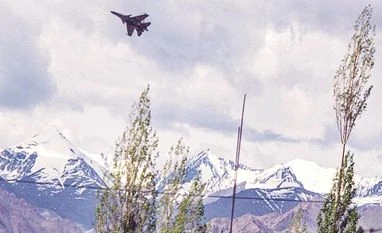 "indian air force, china, border, leh, india-china, ladakh, LAC")