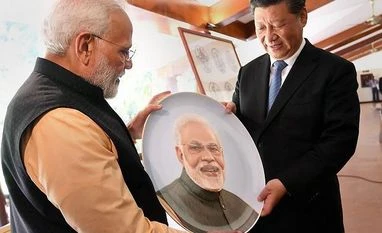
The first are the diplomatic signals. If substantive gains in the two-day meeting were hard to identify, some weight should be given to the fact that the multiple differences were not allowed to escalate — that too, after some aggressive posturing just a month ago at the United Nations General Assembly. This was largely on account of the very visible personal investment by President Xi and Prime Minister Modi to leverage their mutual chemistry and the atmospherics in Mamallapuram to signal the importance they accord to the relations. The second reassuring indicator was the greater emphasis on trade relations with the establishment of a ministerial-level economic and trade dialogue mechanism. This dialogue, to be headed by the Chinese vice-premier and India’s finance minister, will address the vexed issue of the trade imbalance between the two countries — India’s annual trade deficit with China runs over $50 billion — and identify sectors for mutual investment and joint manufacturing partnerships. What also helped was China’s recognition of India’s concerns about the need for a “balance” in the Regional Comprehensive Economic Partnership (RCEP) free-trade pact. From India’s perspective, China remains the chief obstacle in signing the RCEP. That China and India are now ready to discuss these concerns is a clear signal of a more accommodative stance on Beijing’s part. Third, and perhaps no less important, is the reiteration at the summit of two key guiding principles laid down in 2005 on the border issue. Both are key from India’s perspective. One was the acceptance that major geographical features (in other words, the watershed) would be considered in demarcating the borders. The other was taking into account the interests of settled populations (with implications for the people of the border town of Tawang). Previously, Chinese leaders had walked back from these principles, so the fact that they were restated at Mamallapuram is constructive.
That said, Mr Xi’s back-to-back visit bearing funds and investment proposals to Nepal, India’s traditional geo-political partner, suggests that China is unlikely to slacken the relentless pursuit of its geo-political interests in South Asia. Taken together with the high-profile meeting in New York last month of the foreign ministers of the Quad grouping — Japan, Australia, the US, and India — designed to balance China’s clout in the Indo-Pacific, it is clear that neither country is ready to back down on the many prickly issues in its bilateral relations. There was, however, some comfort for India that Kashmir did not figure in the discussion, with Mr Xi not raising it and instead simply briefing Mr Modi about the Pakistan prime minister’s visit to Beijing on October 8. But most importantly, the informal summit in Mamallapuram, like the earlier one in Wuhan, has once again underlined the importance of dialogue and communication, with Mr Modi accepting Mr Xi’s invitation for a third meeting next year. In that sense, Mamallapuram has moved the needle on the relations between the two countries.


 "Modi, xi jinping")