


Part 2: Brahmin to Dalit - Caste jealousy beneath Telangana's Vedic welfare plan
In this concluding piece of a two-part series, Business Standard reports how Telangana's welfare politics risks fomenting inter-caste hatred
 "KC Rao, telangana")
premium
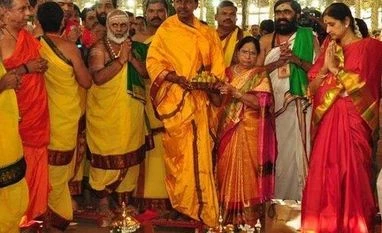
Telangana CM KCR with Brahmin priests at a state-organised ritual. Photo courtesy: Rediff
“BRAHMIN stands for Broad and Brilliant in Thinking, Righteous and Religious in Livelihood, Adroit and Adventurous in Personality, Honesty and Humanity in Quality, Modesty and Morality in Character, Innovation and Industry in Performance, and Nobility and Novelty in Approach,” reads the charter of the Telangana government-funded Brahmin Samkshema Parishad, in an apparent display of acronymical acrobatics that could give acronym afficionados writing speeches for India’s tallest leaders a run for their money.
Brahmin bounty: Not politically suicidal in Telangana
One of the most striking aspects of the caste push is Chief Minister KCR’s open pitch for ‘Brahmin upliftment’ Telangana. In most states of India, any open endorsement of Brahminical ideals would be deemed politically suicidal, but KCR seems to have bucked the trend – at least for now. In 2017, the government formed an association exclusively for the uplift of the community. This association oversees a plethora of schemes for Brahmins unheard of in any state across the country. While even the central government uses the term economically backward classes (EWC), subtly talking of Brahmins, the Telangana government makes no bones about being benevolent to the community. The government’s charter further notes, “Brahmins known for their idealistic way of life remained backward when the rest of the society progressed materialistically. The government of Telangana acknowledged this fact and identified the need that Brahmins in the state should be given strong economic support for their upliftment.”
Brahmin students whose parents earn less than Rs 5 lakh a year are given scholarships of up to Rs 20 lakh by the state government, under a scheme named after Swami Vivekananda, for pursuing a masters’ degree or post-doctoral studies overseas (Dalit students are also eligible for a similar scheme). Below poverty line (BPL) Brahmins are fully funded for their college education under a scheme named after saint Ramanuja. Those willing to pursue Vedic education and want to become priests are provided monetary support of Rs 3 lakh. Women are paid a similar sum as incentive to marry Brahmin temple priests, as the KCR government considers them to be conjugally undesirable owing to their low earning potential.
No beggar thy neighbour; no caste jealousy
The pandering to each caste and the targeted use of welfare economics to solicit their support has also constricted, if not eliminated, the probability of inter-caste envy to various schemes. “Dalits in Telangana have bigger families than other castes. Dalit Bandhu is a good scheme, as it will help lift entire families or maybe an entire generation out of poverty. An enterprising Dalit can easily use the Rs 10 lakh grant to make another Rs 50 lakh,” says A Srinivas, a businessman and functionary of the washerman caste’s forum, when asked about his thoughts on KCR’s scheme for Dalits.
“We welcome schemes for the poorest of the poor among all castes. Only the most backward castes should get the benefits of the monetary schemes first. Upper castes (Brahmins) are just eight per cent of Telangana’s population. So, the government should get its priorities right,” says P Shankar of the Dalit Bahujan Front, when asked about government funds being given to Brahmins.
“Brahmins are economically backward. That’s why they were helped by KCR. Every economically backward person should get help from the government. Dalit Bandhu is a historical move. A Dalit driving a truck will now own it. A Dalit working in someone’s field can now be a landowner. The possibilities are infinite,” says Vannam Narasimha Rao of the state’s Brahmin forum, when asked about the freebies given to Dalits and Yadavs.
“By giving free power, land and trucks to fishermen (Mudiraj caste) and Nayee Brahmins (barber caste), KCR is trying to carve a vote bank for himself. His aura as the champion of a separate Telangana state is fading. Politics aside, there is little doubt that every single scheme is benefitting the caste it is meant for,” says Lakshmana Yadav, vice-president of the state’s influential Yadav caste forum, on KCR’s largesse for castes other than his own.
However, irrespective of such inter-caste bonhomie before the press, intra-caste fissures have emerged in the past when it comes to hogging the biggest slice of the pie. Take for instance Mr Yadav’s caste, which has been opposing other sub-castes in the larger shepherding community from being listed as beneficiaries of the subsidised sheep and other monetary schemes. Reports suggest that the Yadavs have been opposing the entry of Kurumas, another pastoral caste, into the list of beneficiaries. Similarly, those from the dominant fisherman caste Gangaputra have been against enlisting another fisherfolk sub-caste Mudiraja as recipient of subsidised mopeds and trucks.
“There are two million Rajakas in Telangana, but the government says there are only 40,000. We should also get a scheme like Dalit Bandhu. We are more backward than Dalits and deserve Rajaka Bandhu,” says Tilakarajan Chimmaiah, a member of the washerman caste from Nalgonda district.
Caste economics & welfare politics: Familiar bedfellows
KCR has the fiscal and political space to prepare the ground for his return for a third consecutive term as CM in 2024. In 2021-22, Telangana announced a Budget of Rs 2.31 trillion – an increase of 28 per cent over last year. While Budget documents show that the estimated allocation to funds meant for scheduled castes and backward classes would be around Rs 14,500 crore, the state’s finance minister and KCR’s son, Harish Rao, pegged the figure before the media at over Rs 21,000 crore.
If the state does end up spending these amounts on backward classes, comprising 52 per cent of the state’s population, it would mean a 50 per cent spike in expenditure on these castes when compared with last year. Although allocations to the special fund for these castes account for just 10 per cent of Telangana’s Budget, every department makes additional allocations in its sub-plans which is spent on caste-specific schemes. For instance, the schemes for toddy tappers, fishermen, barbers, weavers, etc, are allocated roughly Rs 100 crore a year to be spent by the state’s education, industries, social welfare and culture ministries.
The state’s expenditure has increased 28 per cent every year since KCR came to power for a second term in 2019. Its tax revenues have grown by less than five per cent during the same period. While the state’s fiscal deficit still hovers around the prescribed limit of three per cent, the exponential outgo in the absence of concomitant revenue streams could jeopardise its ambitious caste welfare programmes in the years to come.
Brahmin bounty: Not politically suicidal in Telangana
One of the most striking aspects of the caste push is Chief Minister KCR’s open pitch for ‘Brahmin upliftment’ Telangana. In most states of India, any open endorsement of Brahminical ideals would be deemed politically suicidal, but KCR seems to have bucked the trend – at least for now. In 2017, the government formed an association exclusively for the uplift of the community. This association oversees a plethora of schemes for Brahmins unheard of in any state across the country. While even the central government uses the term economically backward classes (EWC), subtly talking of Brahmins, the Telangana government makes no bones about being benevolent to the community. The government’s charter further notes, “Brahmins known for their idealistic way of life remained backward when the rest of the society progressed materialistically. The government of Telangana acknowledged this fact and identified the need that Brahmins in the state should be given strong economic support for their upliftment.”
Brahmin students whose parents earn less than Rs 5 lakh a year are given scholarships of up to Rs 20 lakh by the state government, under a scheme named after Swami Vivekananda, for pursuing a masters’ degree or post-doctoral studies overseas (Dalit students are also eligible for a similar scheme). Below poverty line (BPL) Brahmins are fully funded for their college education under a scheme named after saint Ramanuja. Those willing to pursue Vedic education and want to become priests are provided monetary support of Rs 3 lakh. Women are paid a similar sum as incentive to marry Brahmin temple priests, as the KCR government considers them to be conjugally undesirable owing to their low earning potential.
No beggar thy neighbour; no caste jealousy
The pandering to each caste and the targeted use of welfare economics to solicit their support has also constricted, if not eliminated, the probability of inter-caste envy to various schemes. “Dalits in Telangana have bigger families than other castes. Dalit Bandhu is a good scheme, as it will help lift entire families or maybe an entire generation out of poverty. An enterprising Dalit can easily use the Rs 10 lakh grant to make another Rs 50 lakh,” says A Srinivas, a businessman and functionary of the washerman caste’s forum, when asked about his thoughts on KCR’s scheme for Dalits.
“We welcome schemes for the poorest of the poor among all castes. Only the most backward castes should get the benefits of the monetary schemes first. Upper castes (Brahmins) are just eight per cent of Telangana’s population. So, the government should get its priorities right,” says P Shankar of the Dalit Bahujan Front, when asked about government funds being given to Brahmins.
“Brahmins are economically backward. That’s why they were helped by KCR. Every economically backward person should get help from the government. Dalit Bandhu is a historical move. A Dalit driving a truck will now own it. A Dalit working in someone’s field can now be a landowner. The possibilities are infinite,” says Vannam Narasimha Rao of the state’s Brahmin forum, when asked about the freebies given to Dalits and Yadavs.
“By giving free power, land and trucks to fishermen (Mudiraj caste) and Nayee Brahmins (barber caste), KCR is trying to carve a vote bank for himself. His aura as the champion of a separate Telangana state is fading. Politics aside, there is little doubt that every single scheme is benefitting the caste it is meant for,” says Lakshmana Yadav, vice-president of the state’s influential Yadav caste forum, on KCR’s largesse for castes other than his own.
However, irrespective of such inter-caste bonhomie before the press, intra-caste fissures have emerged in the past when it comes to hogging the biggest slice of the pie. Take for instance Mr Yadav’s caste, which has been opposing other sub-castes in the larger shepherding community from being listed as beneficiaries of the subsidised sheep and other monetary schemes. Reports suggest that the Yadavs have been opposing the entry of Kurumas, another pastoral caste, into the list of beneficiaries. Similarly, those from the dominant fisherman caste Gangaputra have been against enlisting another fisherfolk sub-caste Mudiraja as recipient of subsidised mopeds and trucks.
“There are two million Rajakas in Telangana, but the government says there are only 40,000. We should also get a scheme like Dalit Bandhu. We are more backward than Dalits and deserve Rajaka Bandhu,” says Tilakarajan Chimmaiah, a member of the washerman caste from Nalgonda district.
Caste economics & welfare politics: Familiar bedfellows
KCR has the fiscal and political space to prepare the ground for his return for a third consecutive term as CM in 2024. In 2021-22, Telangana announced a Budget of Rs 2.31 trillion – an increase of 28 per cent over last year. While Budget documents show that the estimated allocation to funds meant for scheduled castes and backward classes would be around Rs 14,500 crore, the state’s finance minister and KCR’s son, Harish Rao, pegged the figure before the media at over Rs 21,000 crore.
If the state does end up spending these amounts on backward classes, comprising 52 per cent of the state’s population, it would mean a 50 per cent spike in expenditure on these castes when compared with last year. Although allocations to the special fund for these castes account for just 10 per cent of Telangana’s Budget, every department makes additional allocations in its sub-plans which is spent on caste-specific schemes. For instance, the schemes for toddy tappers, fishermen, barbers, weavers, etc, are allocated roughly Rs 100 crore a year to be spent by the state’s education, industries, social welfare and culture ministries.
The state’s expenditure has increased 28 per cent every year since KCR came to power for a second term in 2019. Its tax revenues have grown by less than five per cent during the same period. While the state’s fiscal deficit still hovers around the prescribed limit of three per cent, the exponential outgo in the absence of concomitant revenue streams could jeopardise its ambitious caste welfare programmes in the years to come.