


The Land Trap: How land, real estate investment can destabilise the economy
Mr Bird's book is an interesting contribution to understanding why land continues to occupy such a role in modern economies and the trajectories of nations
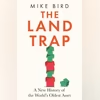 "The Land Trap: A New History of the World's Oldest Asset")
premium
The Land Trap: A New History of the World's Oldest Asset
5 min read Last Updated : Jan 12 2026 | 11:19 PM IST


Listen to This Article
The Land Trap: A New History of the World's Oldest Asset
by Mike Bird
Published by
Hachette India
336 pages ₹799
Land has long occupied a peculiar position in political economy, partly due to its distinct characteristics. In The Land Trap: A New History of the World’s Oldest Asset, Mike Bird seeks to re-centre land as a force that has shaped the economic trajectories and political outcomes of different nations. His argument rests on the notion that land is categorically distinct from other forms of capital. Its absolute rigidity of supply defines land. Unlike goods or instruments, land cannot be produced in response to its rising demand. This scarcity ensures that intensified investment fuels speculation and price inflation, often with destabilising consequences. Equally significant is land’s immobility. Its permanence allows it to function as a store of wealth and a cornerstone of collateral-based financial systems. As a result, fluctuations in land prices reverberate far beyond property markets, transmitting shocks throughout the broader economy. These characteristics explain why land has become a source of economic fragility.
This is hardly a new observation. What is new, Mr Bird argues, is the transformation of land into a fully financialised object. This shift, driven largely by banking systems, marks a break from earlier forms of landholding. Under this shift, land circulates through markets much like manufactured goods or capital. The consequence of this shift is the re-emergence of land as a central axis of power. As Mr Bird often mentions, real estate became the preferred form of collateral, regulating credit expansion. This dynamic explains his argument, encapsulated in the concept of the “land trap.” Land is attractive in this regard as it does not physically depreciate, and its immobility renders it a seemingly stable anchor for credit creation. But these same qualities make land speculation dangerously seductive. When financial systems become dependent on escalating land prices, they lead to cycles of leverage, inflation, and prolonged but inevitable collapse. Mr Bird shows that the manifestations of such land traps vary across contexts, but the trajectory is somewhat the same. Booms driven by land-backed credit generate short-term growth while creating long-term fragility.
The book has a particular emphasis on East and Southeast Asia. For instance, Mr Bird contrasts Singapore’s approach with Hong Kong’s. In both countries, the formal ownership of land ultimately resides with the state. Yet despite this shared starting point, the two diverged sharply. Hong Kong became increasingly ensnared in the land trap, as escalating land prices were allowed to underpin speculative finance and fiscal revenue. Singapore used state control over land to regulate markets and manage development in line with broader social and economic goals.
Mr Bird also devotes chapters to explain the extraordinary reach of Henry George’s ideas and their subsequent disappearance from the political mainstream. George, best known for advocating a “single tax” on land, was among the most influential figures of his era. In the late nineteenth century, his ideas circulated across continents, and his book Progress and Poverty (1879) was, as Mr Bird suggests, possibly the most significant work of political writing of its century. George succeeded in assembling an unusually broad coalition, which was expansive and socially heterogeneous, including groups that wouldn’t find a common cause otherwise. Yet his influence proved short-lived. Mr Bird is careful to situate George within a wider history of land reform and redistribution. While his vision lacked the scale of twentieth-century revolutionary reforms, it nonetheless entailed a restructuring of property relations. Reactions captured this discomfort vividly. As The Times of London remarked, it would be easier to take George seriously once he abandoned the idea that social harmony required “appropriating the property of others.”
When an economy becomes structurally dependent on land, extricating itself from that dependence proves exceptionally difficult. Across much of the West and parts of Asia, this dependence manifests in disproportionately harmful effects. Because land and real estate are so deeply entwined with the financial system, price declines threaten systemic instability. The broader conclusion is that the political economy of land is uniquely rigid. Unlike other policies and systems, land institutions are resistant to reform once entrenched. This vulnerability underpins what can be identified as the dilemma of land-based economies. Prolonged real estate booms, while politically popular, sap dynamism from other sectors by diverting capital, and credit into property.
There is, unfortunately, a certain looseness in the narrative. Mr Bird frequently draws large comparative lines, but these insights are not always pursued with depth. Relatedly, the book occasionally rests substantial interpretive weight on a set of figures, ideas, or case studies. Another absence lies in the social consequences. The book devotes little attention to the social ramifications of land regimes. Regions where land does not occupy the same central position in the political economy or where alternative land regimes have produced different outcomes could have provided valuable counterpoints. Despite these omissions, Mr Bird’s book is an interesting contribution to understanding why land continues to occupy such a role in modern economies and the trajectories of nations.
X/Insta: @ananyaprs
Topics : BOOK REVIEW land rates Real Estate Indian Economy