


ICICI Bank's Q4FY25 results: Net profit up 18% to Rs 12,630 crore
On a consolidated basis, the bank's net profit grew 15.7 per cent to Rs 13,502 in Q4FY25 from Rs 11,672 crore in Q4FY24
 "ICICI Bank has set up a branch at the Maha Kumbh Mela Ground in Prayagraj to provide essential banking services to pilgrims and visitors during the event")
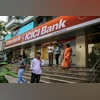
The bank’s provisions (excluding provision for tax) were increased to Rs 891 crore for the quarter ended March from Rs 718 crore a year ago. | File Photo
Listen to This Article
ICICI Bank’s standalone net profit rose by 18 per cent year-on-year (Y-o-Y) to Rs 12,630 crore for the quarter ended March for the financial year 2024-25 (Q4FY25) on the back of healthy treasury gains and rise in fee income.
Treasury gains were Rs 239 crore during the period, compared to a loss of Rs 281 crore in Q4FY24.
On a consolidated basis, the bank's net profit grew 15.7 per cent to Rs 13,502 in Q4FY25 from Rs 11,672 crore in Q4FY24.
Net interest income (NII) increased by 11 percent Y-o-Y to Rs 21,193 crore for Q4FY25 from Rs 19,093 crore in Q4FY24. Consequently, the net interest margin (NIM) was at 4.41 per cent for Q4FY25 as compared to 4.25 per cent in Q3FY24. The NIM for FY25 was 4.32 per cent.
The movement in NIM was primarily driven by a cut in the cash reserve ratio (CRR) in Q3FY25 and interest on tax refunds, said Sandeep Batra, Executive Director in a post earnings conference call. However, the upside movement in NIM was partly offset by cuts in the repo rate and increase in cost of funds, he added.
Also Read

 "ICICI Bank")
 "ICICI Bank has set up a branch at the Maha Kumbh Mela Ground in Prayagraj to provide essential banking services to pilgrims and visitors during the event")
 "Sensex, Nifty, stock brokers")
 "ICICI Bank")
Looking ahead, the movement in NIM, in the near term, will be by and large aligned with the happenings in the banking system. “NIM was around 4% prior to commencement of rate cycle in FY22. And with increase in repo rates and NIM movement to the level, we had moved it about 4.5% over the last two years, before it has declined to about 4.3% during the current year. In the near term, I think we will follow, by and large, what's happening in the banking system. And these margins would be impacted by repo rate cuts. And we do expect more repo rates to happen,” said Batra.
Non-interest income, excluding treasury, increased by 18.4 per cent year-on-year to Rs 7,021 crore in Q4FY25 from Rs 5,930 crore in the year ago period. Fee income grew by 16.0 per cent year-on-year to Rs 6,306 crore from Rs 5,436 crore.
On the asset quality front, the bank’s net performing asset ratio (NPA) declined to 0.39 per cent from 0.42 per cent sequentially. The provisioning coverage ratio (PCR) on non-performing loans was 76.2 per cent as of March 31. The bank’s provisions (excluding provision for tax) were increased to Rs 891 crore for the quarter ended March from Rs 718 crore a year ago.
As far as slippages are concerned, the bank had total gross additions in NPAs of about Rs 5,100 crore out of which retail and rural were about 4,300 crores, and corporate and business banking were 803. Along with this, there have been recoveries and upgrades. Recoveries in the retail and rural portfolio were about RS 3,000 crores. And corporate and business banking recoveries were of about Rs 778 crores. So the net additions have been just about 1,300 crores. “I think we continue to remain focused on both the quality of our customers, and that strategy continues to remain unchanged. We are not seeing any specific trends per se, but we will be closely monitoring our portfolio to identify any build-up of early stress. But at this point of time, the portfolio is quite stable,” said Batra.
The bank’s total capital adequacy ratio was 16.55 per cent and CET-1 ratio was 15.94 per cent. The board has recommended a dividend of Rs 11 per share for FY25. The declaration and payment of dividend is subject to requisite approvals.
Total period-end deposits increased by 14.0 per cent Y-o-Y to Rs 16.1 trillion. The net domestic advances grew by 13.9 per cent Y-o-Y to Rs 13.1 trillion.
The retail loan portfolio grew by 8.9 per cent Y-o-Y and 2.0 per cent sequentially, and comprised 52.4 per cent of the total loan portfolio as of March 31.
In total retail portfolio, mortgages and personal loans command the highest share. The unsecured segment comprises 13.4 percent of total retail portfolio, Batra said. On the future course of lending in the unsecured segment, Batra said that the rate of growth in personal loan and credit card has slowed down Y-o-Y. The personal loan portfolio has grown by 4.2 percent and credit card has grown about 11.7 percent. Although the bank has no target but as long as the bank is comfortable with the quality of credit, it will continue to lend to these segments.
Meanwhile, the bank’s corporate loan portfolio has grown 11.9 percent Y-o-Y, at a faster pace than its retail loan book. However, Batra said that the bank does not follow any product mix. The allocation between retail, business banking, rural and wholesale is an outcome rather than a specific strategy. The emphasis is on customers as opposed to focusing on segments.
In deposits, Current Account and Savings Account (CASA) has grown by 10 percent Y-o-Y to Rs 5715. 30 crores. When asked about the impact of the deposit rate cut on CASA, Batra said that deposits have witnessed a healthy growth with average current account deposits increased by 11.7 percent y-o-y and average savings account deposits increased by 10.2% y-o-y in FY2025. The periodic deposit was about 14 percent, and the banking system grew at about 10 percent. The focus of the bank is essentially on quantum and cost of deposit mobilization. Going forward, growth in deposits will depend on the regulatory environment therefore, the bank will continue to maintain a nimble approach and will react to both risk and opportunities in an appropriate fashion.
Further, as of March 31, the Bank held Government guaranteed SRs amounting to" 1,694.45 crore, which were fully provided. The Bank, on a prudent basis, continues to hold provision against such SRs which will be reversed on actual receipt of recoveries or approval of claims, if any, by the Government. The Board has authorised the buyback of debt securities.
On expanding its physical reach, the bank opened 624 branches last year. Further, on raising funds via AT-1 bonds and via other debt issuances, Batra said that the bank has no plans of raising funds.
More From This Section
 "Yes Bank, yes bank New Logo")
 "HDFC Bank, HDFC")
 "HDFC Bank")
 "New India Co-operative Bank")
 "fund, revenue")
Topics : ICICI Bank Private banks Indian banking sector
Don't miss the most important news and views of the day. Get them on our Telegram channel
First Published: Apr 19 2025 | 5:10 PM IST